Community connections - 5
BIKING ON THE EDGE:
A Social Permaculture Tour of Amsterdam Noord
On a beautiful, sunny spring day in May, we led 20 students from our Urban Permaculture Design Course on a bicycle tour through Amsterdam Noord as an exploration of the concept of ‘social permaculture’. The north of Amsterdam, separated from the rest of the city by the River IJ, radiates a rough, edgy, creative buzz. It is a unique convergence between remnants of an industrial past, working class neighborhoods, and a plethora of pioneering and transformational initiatives focusing on food, nature, community, culture and local economy. Sadly, like the rest of Amsterdam, all of this is threatened by a steady march towards gentrification.
“It was inspiring to see so many examples of different ways of connecting people to their food and nature locally, on our doorstep!”
~Jules, Urban PDC participant
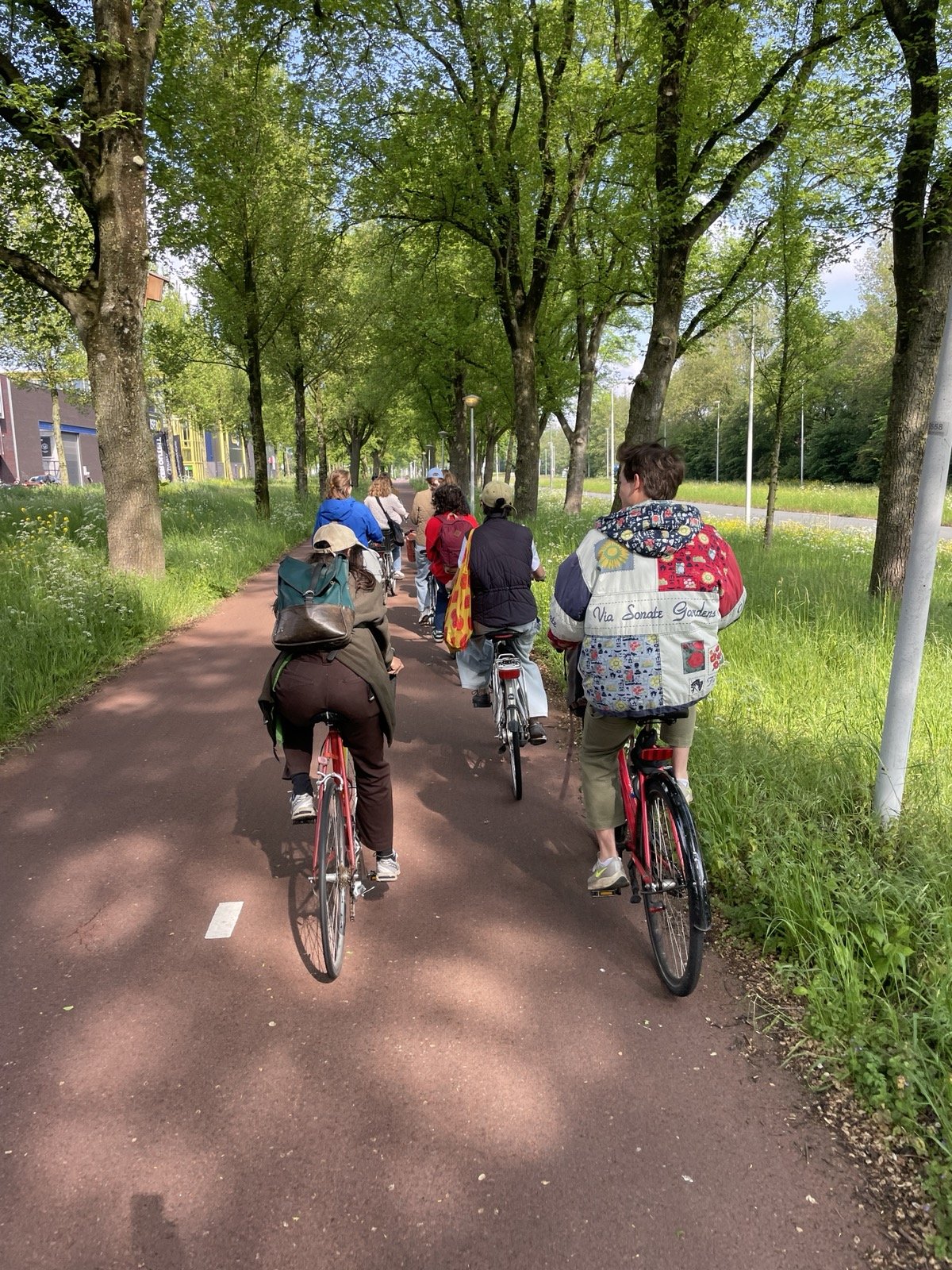
Biking through Amsterdam Noord
Using edges and valuing the marginal
The idea that the interface between two environments—the edge—is the most diverse, fertile and productive place in a system is a lovely and eye-opening permaculture principle. In the 17th century, Amsterdam Noord was truly on the outskirts: a marshy, brackish bay that was also the site of the gallows field where the corpses of criminals were hung as a warning.
In the 19th century, the digging of the North Sea canal that connected this desolate area to the sea transformed Amsterdam Noord into a hub for shipbuilding and other industries. Ketjen, a petrochemicals company, also moved its factory from the city centre, where it was considered a nuisance, across the IJ, where it remains to this day. Fokker’s aircraft factory arrived soon afterwards, and Shell joined the party by establishing a 27-hectare research centre.
Workers’ paradises
In the 1900s, the city built ‘tuindorpen’ (garden villages) for workers and their families. The vision behind these ‘arbeidersparadijzen’ (workers’ paradises) was to allow workers to live comfortably – in contrast to the poor housing options in the city centre for the working class. Today, the tuindorpen are protected: communities of single-story homes with intricate brickwork, front and back gardens, surrounded by tree-lined streets and open communal green spaces. Their leafy beauty stands in contrast with the area’s abandoned industrial buildings and new modern highrises.
In the following decades in the mid-20th century, Amsterdam North became a busy industrial powerhouse, with a proud and independent working class that was isolated from the rest of the city due to the River IJ. In the 1970s, however, shipbuilding started to decline, due to competition from low-wage countries and the international energy crisis. Poverty increased through the 1980s as factories closed and jobs disappeared. Amsterdam North became depressed and run-down.
In the 1990s, in a textbook example of the gentrification process, Noord’s empty warehouses and abandoned spaces catalysed a wave of squatting, and artists and various creative and political initiatives were launched by young people students. At the same time, private developers began to invest in Noord, and more affluent families flocked across the river, driving up rents and property taxes and displacing lower-income people and locally-owned businesses. This gentrification is particularly apparent along the waterfront, where the EYE filmmuseum and the Tolhuistuin have brought mainstream culture and tourism to Shell’s former research terrain and a number of luxury high-rise buildings have sprouted up. In 2018, North became even more attractive as a place to live when a metro was built connecting it with the rest of the city. Although some of these changes have been welcomed by “Noorderlingen”, the newfound popularity of the area has meant that the original social fabric – as well as the existence of many of the creative developments that focus on inclusion, diversity and community (key ingredients of social permaculture!) – are unravelling.
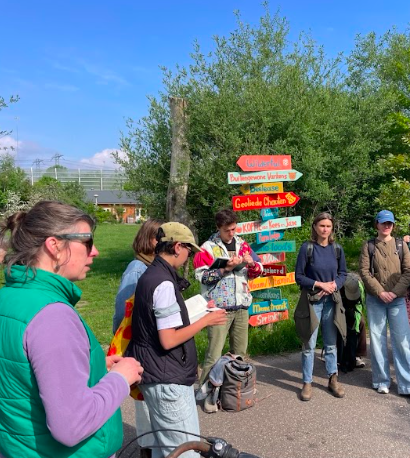
Welcome to Noordoogst!
Noordoogst: growing food and biodiversity
Our bike tour started at Noordoogst, a former sports field that over the past 13 years has blossomed into a beautiful, verdant collective space that is a haven for creeping, crawling and walking creatures alike.
According to the Wat Mag Niet Wijken (What Must Not Give Way) report, an astonishing documentation of the social impacts of 12 ‘temporary’ locations in Amsterdam Noord, Noordoogst exposes some 60,000 people per year to local food production, nature and health. 65 people are employed at the location, 2000 people take part in workshops each year, and there are 3000 volunteers. On top of that, the site produces 20 tons of vegetables, 30 tons of mushrooms, 1.2 tons of meat, 25,000 eggs and 1 ton of harvest from the food forest. In total, Noordoogst alone is responsible for avoiding an astounding 1.5 billion food miles!
It was inspiring to see how a degraded piece of land has become a multilayered ecosystem for all kinds of beings within the space of just over a decade. As we walked around, we were warmly welcomed by the entrepreneurs and volunteers who invested so much in making sure that circularity and solidarity are key underpinnings of this location. They explained how they take special care to be inclusive in their offerings: the CSA and the mushroom farm, for example, offer harvest for locals with less income. The environmental impacts of Noordoogst are likely similarly impressive – we learned that the pigs are fed with leftovers from the beer brewing process, prunings from the grapevines in the vineyard, and leftover harvest from the CSA.
In a cruel irony, the city now has plans to revert this urban oasis back into sports fields. The entrepreneurs – CSA farmers, community gardeners, coffee roasters, beekeepers, butterfly educators, beer brewers, foragers, outdoor childcarers, winemarkers at the collective vineyard, vegetarian take-away cooks, artisanal smokers, mushroom growers, pig farmers and the owners of a farm lodge came up with an alternative plan for an integrated approach with a ‘Sport and Food Park’ that would integrate food production with more conventional sports. However, although the city acknowledged that it recognises the social value provided to the city by Noordoogst, starting in 2027 its area will soon be reduced by half and sports fields and buildings will replace the area’s current social, cultural and environmental biodiversity.
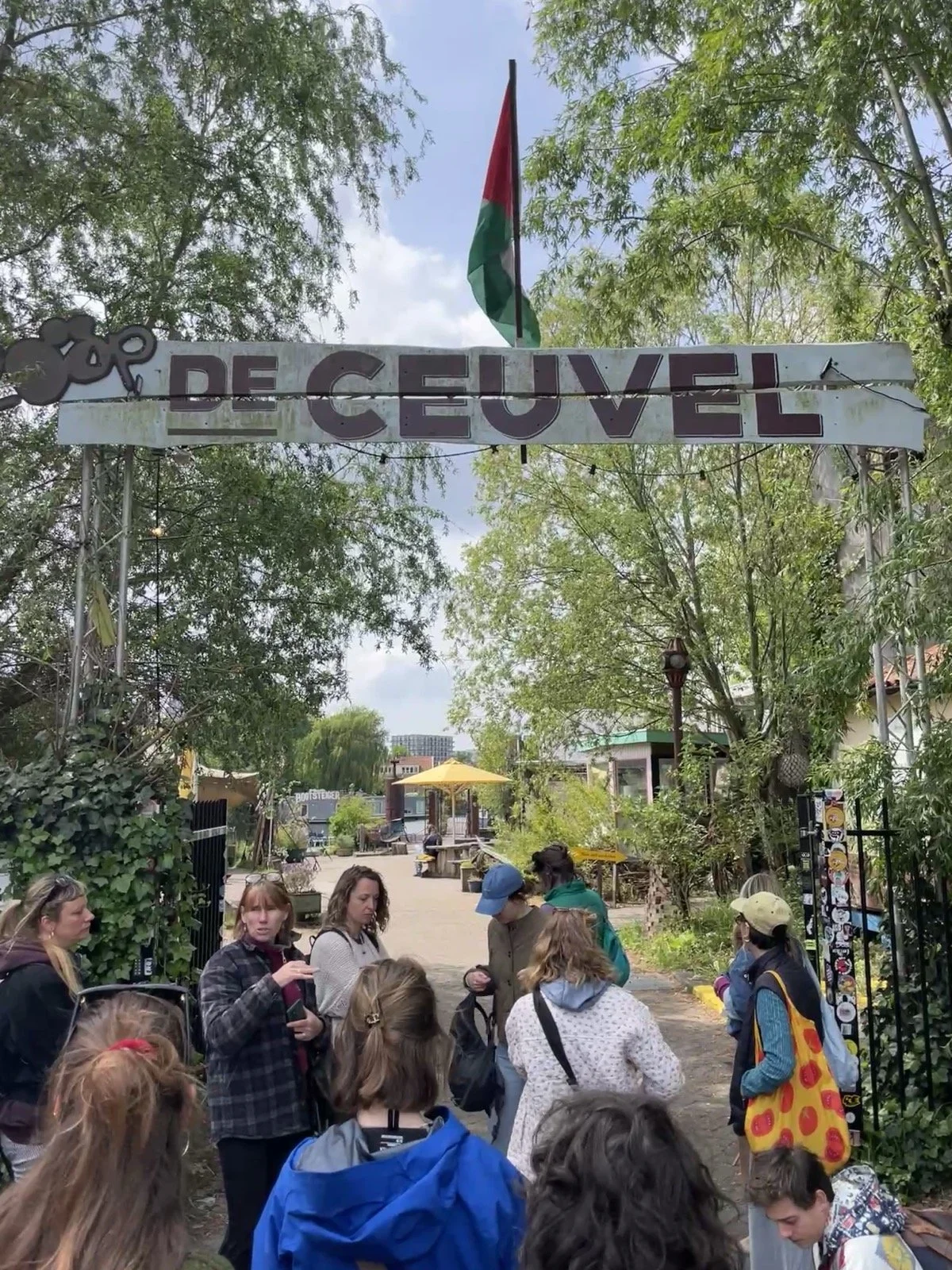
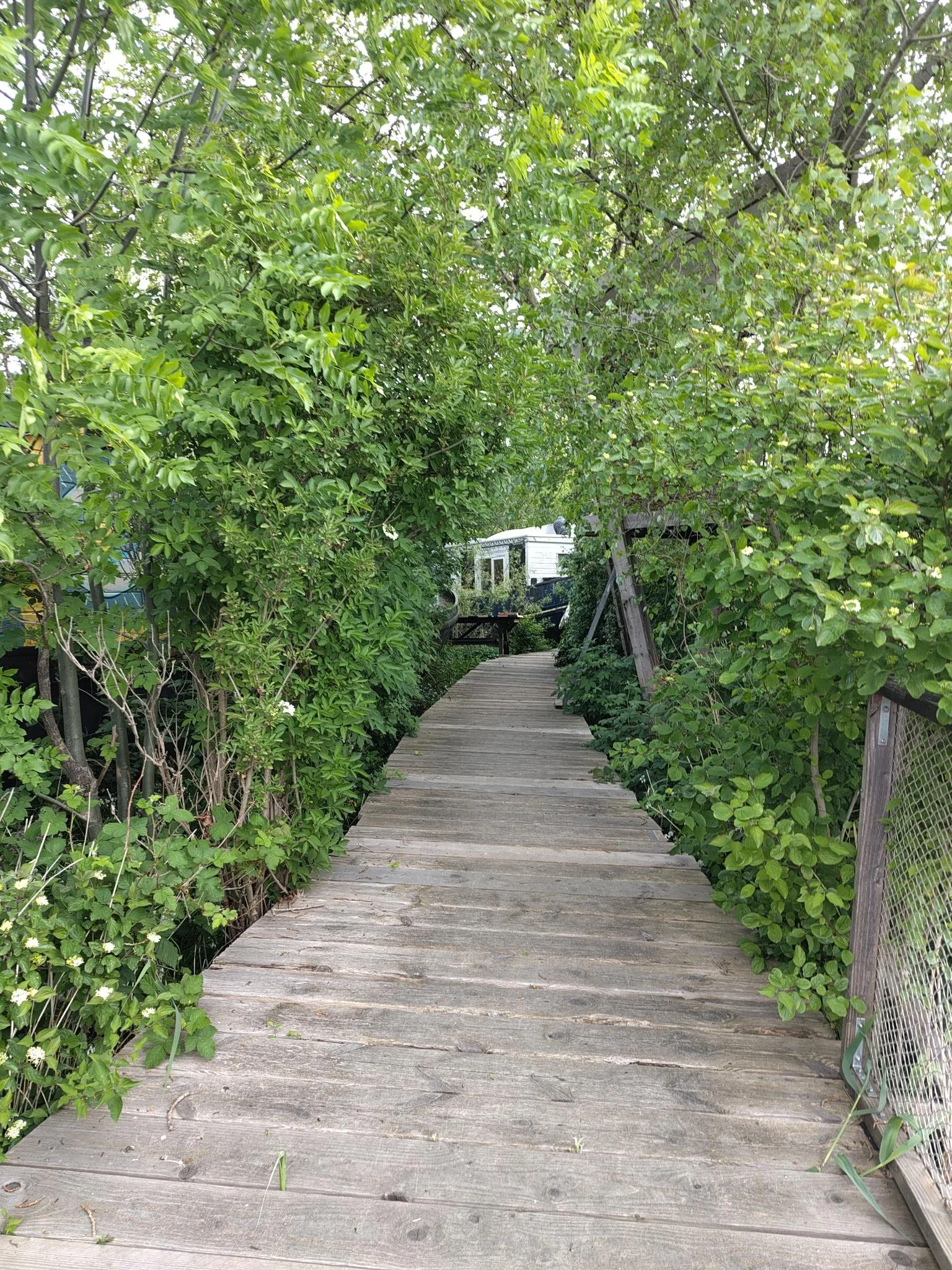
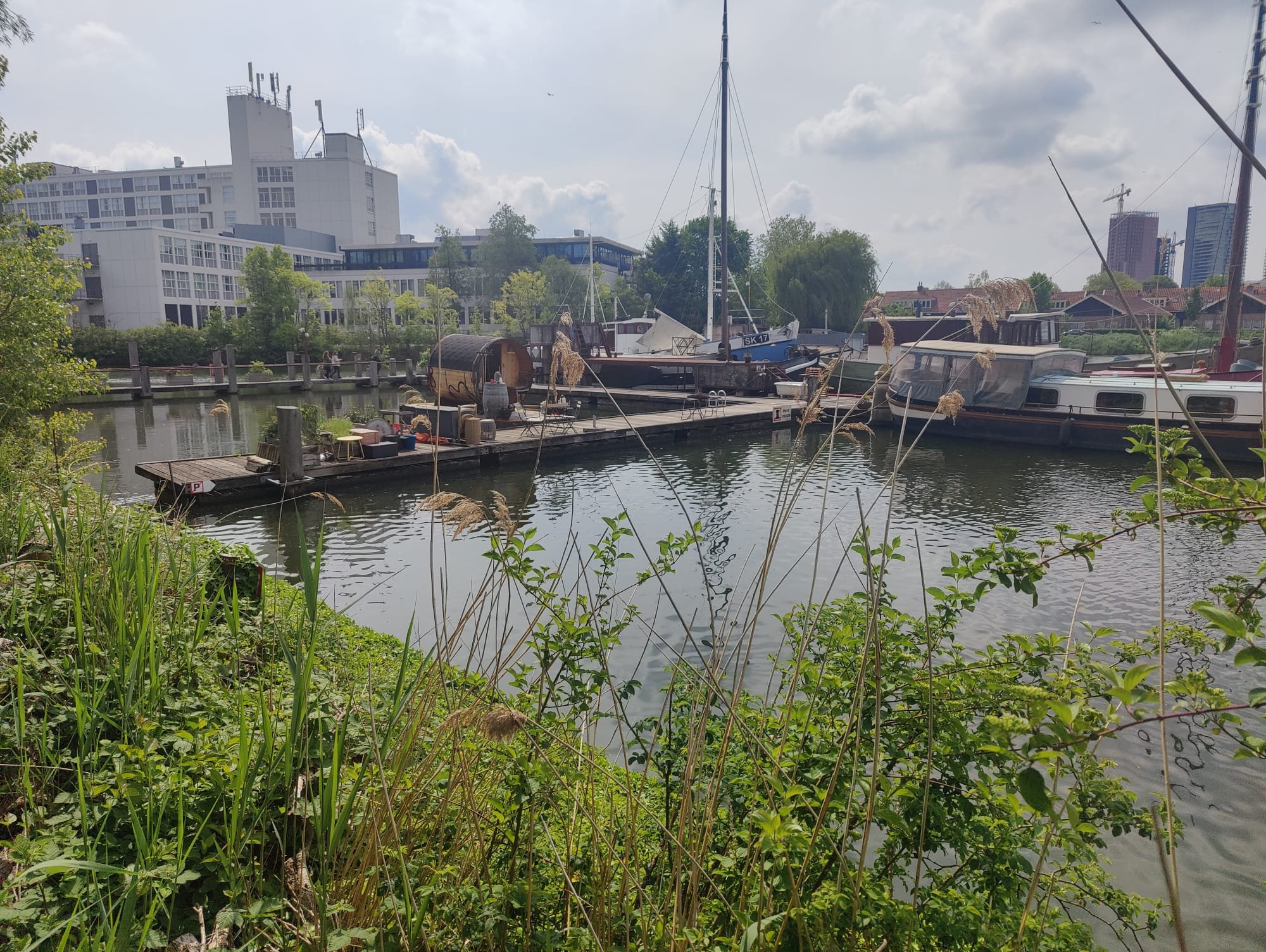
The winding jetty at the Ceuvel, and a view of the sauna.
De Ceuvel: playground for innovation
The next location on the tour is a well-known pioneer in the social transition towards circular societies – even outside of Amsterdam. De Ceuvel, a colourful and captivating hodgepodge of buildings created over the past decades from materials recycled from the scrapyard, is located on the site of a shipyard that closed in 2000.
In 2012, a group of architects won a tender for a ten-year lease from the municipality to regenerate the heavily polluted site into a “city playground for innovation, experimentation and creativity.” Old houseboats were placed along a winding jetty and retrofitted into ateliers and workspaces fitted with clean technologies. The lush greenery surrounding them is a ‘forbidden garden’, an experiment in phytoremediation to clean the soil using plants. Various creative and social enterprises operate from the boats, including The Pollinators (who coordinate the popular annual ‘Food Bank for the Bees’) and an oil library where nuts and seeds are pressed into vegetable oil. The Neighbour Boat is available for free for activities “that contribute to a more connected, creative, and sustainable world and that are publicly accessible and financially inclusive”. The central point is a popular and charming café and restaurant, built from salvaged wood, where locals and tourists enjoy local, sustainable and plant-based food, some of which is produced in the on-site closed-loop aquaponics greenhouse that combines fish and vegetable production.
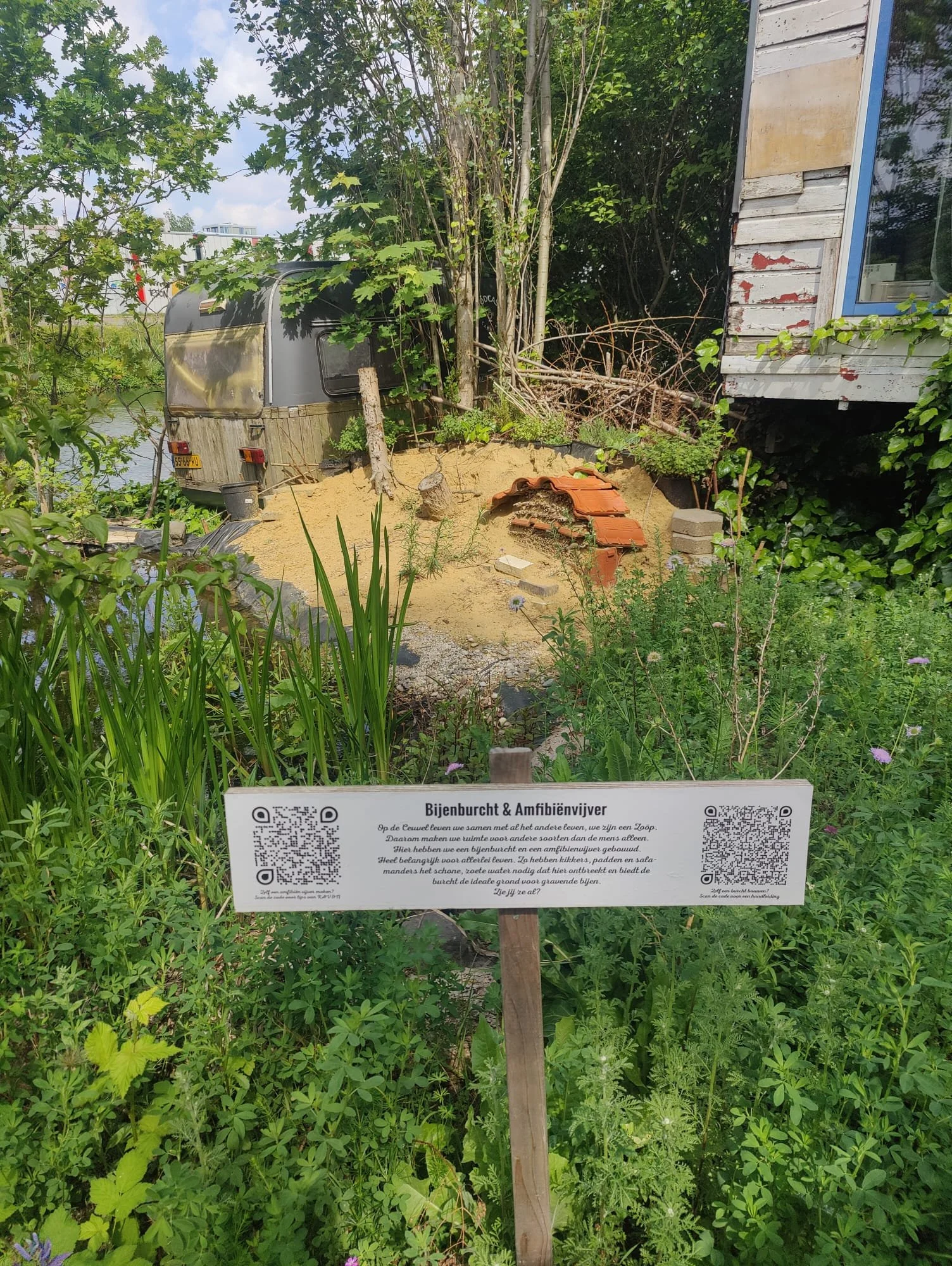
We were inspired to learn that the Ceuvel is a ‘Zoöp’. This concept comes from the term ‘zoöperation’, which means cooperation with all life – not just humans – including the soil, water, plants and creatures that make up the local ecosystem. The Ceuvel has appointed a ‘Speaker for the Living’ who has led an in-depth mapping of all non-human members of the location’s ecosystem and who takes part in decision-making. Zoöp activities have included snorkeling to meet the location’s underwater neighbours, producing a sound collage of ecosystem music including sap streams in trees, building habitat including hedgehog houses, an amphibian pond and a ‘sandarium’ for wild bees, and urban mini-Safaris, led by the Bumblebee Queen, where children can earn ‘pollen points’.
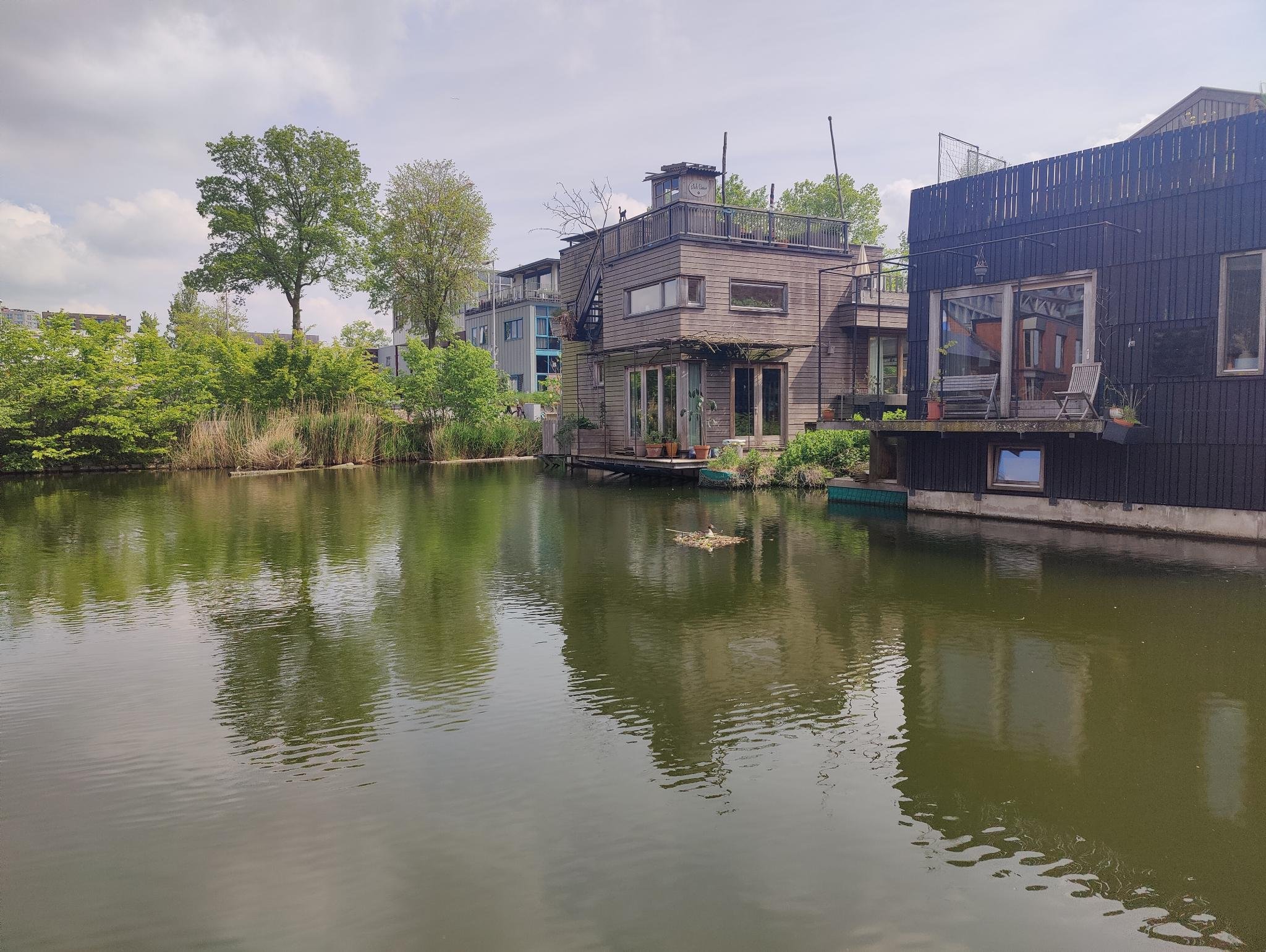
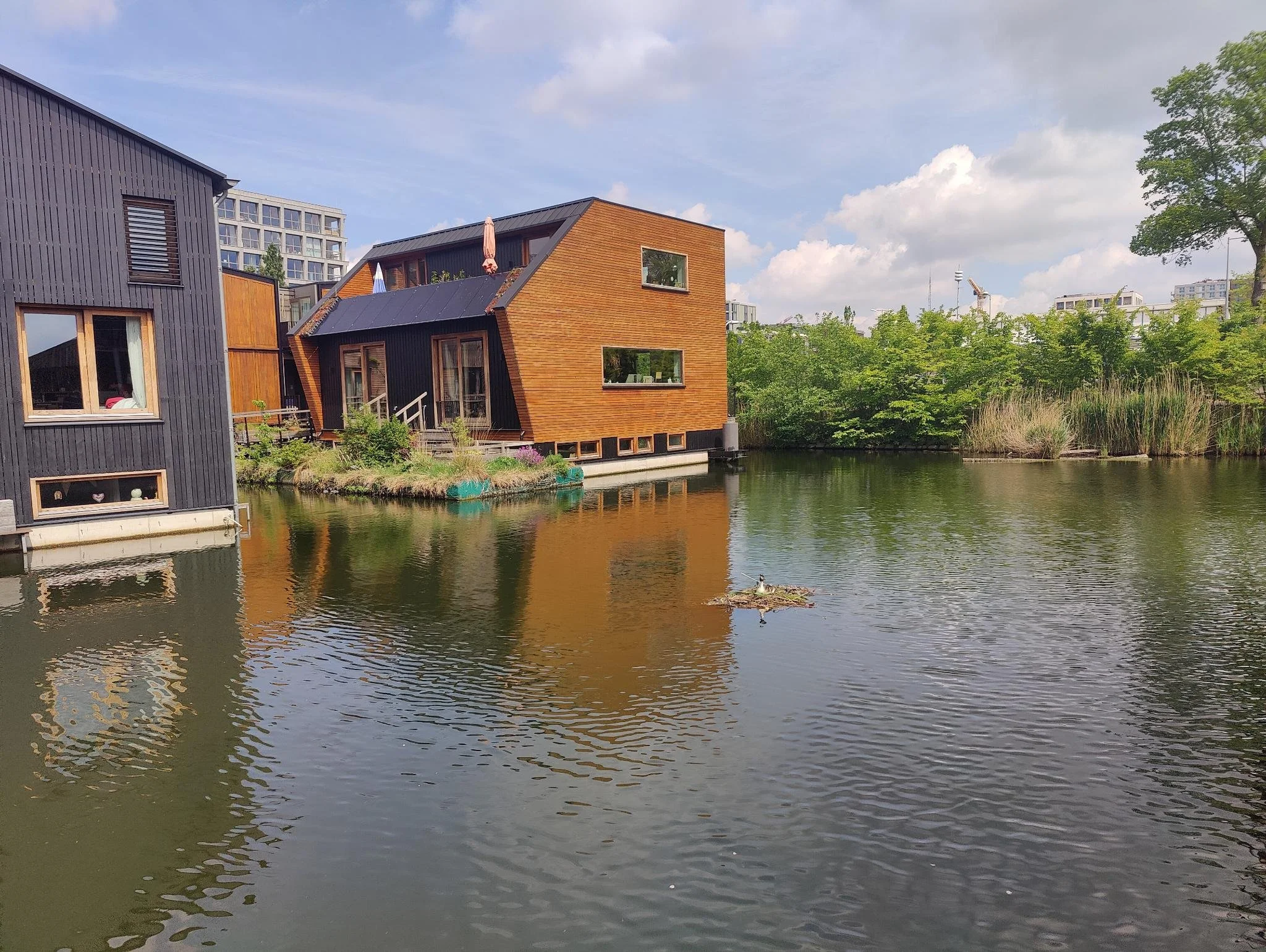
The idyllic Schoonschip floating community
Schoonschip: a floating future
Visible across the water from the winding boardwalk at De Ceuvel is Europe’s most sustainable floating living project: Schoonschip (‘Clean Ship’). We biked over to explore the wooden docks that connect the eclectic arks and to enjoy the sublime views.
Today, Schoonschip is composed of 144 people living in 46 households spread over 30 arks. The project was developed collectively by the residents over a ten-year period starting in 2011: each owner designed their own house, and together they developed a vision for collective facilities and activities. Two of the arks are shared and thus more affordable, and one ark is dedicated to a communal meeting space.
The initiative was designed to be as circular and sustainable as possible. There are a total of 516 solar panels, 30 heat pumps and 60 thermal panels, all connected to a smart grid. The community’s wastewater is circulated, all of the boats have green roofs, and there are floats around the houses covered with plants for biodiversity and water purification.
The Schoonschip community is also pioneering on a social level. All vehicles are shared – electric cars, cargo bikes and regular bicycles. And there are plenty of communal activities for the residents, from childcare to yoga and from movie nights to clothes swaps. The community also has a share in a local CSA, with weekly delivery to the communal space.
Our visit to Schoonschip brought up some interesting food for thought. All of us could envision living very happily in this sustainable urban paradise, but the initial investment costs were out of reach: €70,000 per household to cover collective costs, plus construction costs for the floating homes ranging between €300,000 and €800,000. How can we ensure that such projects are accessible to people of all income levels? Is this even possible within the current economic paradigm?
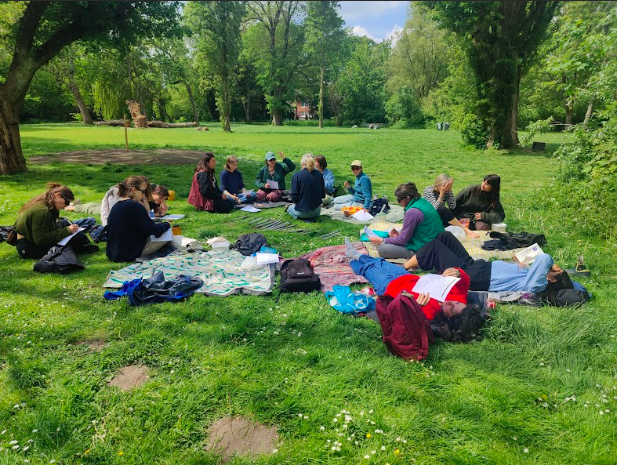
Lunch break and exploration of permaculture principles at the Noorderpark.
Waldorf aan de Werf
We hopped back on our bikes and made a quick pitstop at Waldorf aan de Werf, an elementary school founded by parents that focuses on inclusivity, rhythm of nature and movement. Alexandra from Cityplot, whose two children attend school here, has been involved in creating a magical outdoor space for the children. Together with the help of many parents they have planted a diversity of plants, fruit and nut trees and berries, and placed bird houses and insect hotels.
Greening this schoolyard is a priority for the parents, as the municipality has declared the building as “not fit for schools” due to the busy traffic nearby and it will soon be repurposed. The school has decided to use the marginal as an opportunity: they built a clay pizza oven using local wood from Stadshout. Waldorf aan de Werf is also an Afval naar Oogst compost location, which is just in time for the next school year’s gardening plans. Starting in the fall of 2026, they will create a herb garden and vegetable beds together with the children and neighbours. The (well washed!) harvest will be used in the school’s kitchen, where the cook prepares warm lunches three times per week for the children. All of this was made possible through subsidies and helping hands. And the most beautiful part is that the schoolyard welcomes neighbours to drop by and spend time playing, baking pizza or tending the garden.
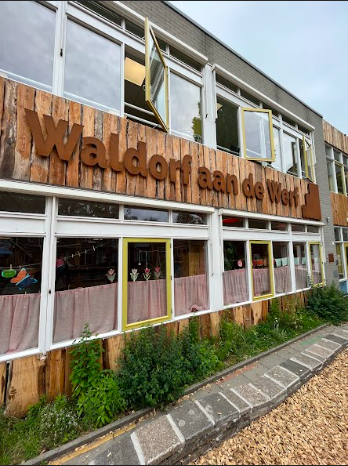
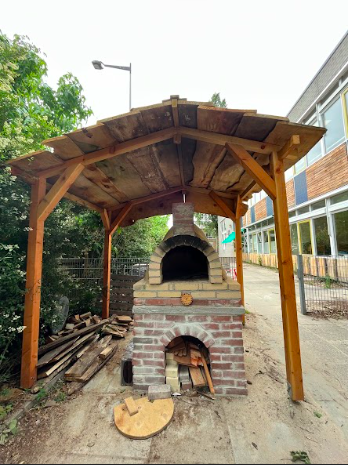
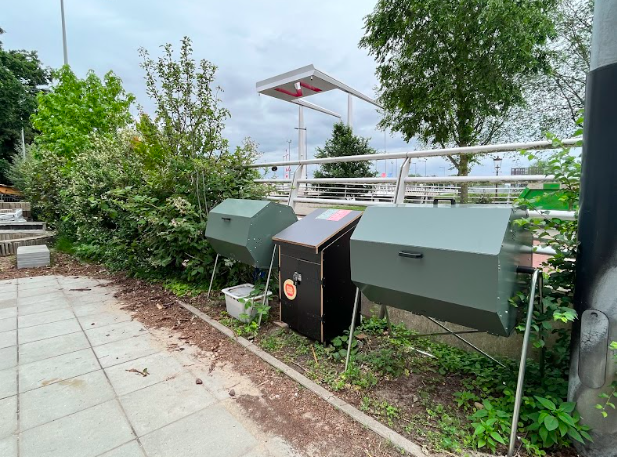
From left to right: Borders filled with plants, Pizza Oven, Afval naar oogst location
Moestuinschool
Our next stop was one of our favourite urban farming destinations in Amsterdam: the Moestuinschool, or Garden School. Since 2021, this green oasis just a stone’s throw from the ferry to Amsterdam Central station has been run by three extremely knowledgeable growers on the former building grounds of the North-South metro line. Each year, from February to November, 20 students receive biweekly lessons and together with a small group manage an area of 45 square meters of veggies. The cost is €1250 per year, which includes all materials and the lessons. The team works with ‘sugar aunts and uncles’ who help finance those who can’t pay the full amount. The teachers also run a regular ‘consultation hour’ where gardeners can come with all kinds of questions. Over the years, the Moestuinschool has trained more than 100 urban gardeners who have gone on to make the city more social and edible.
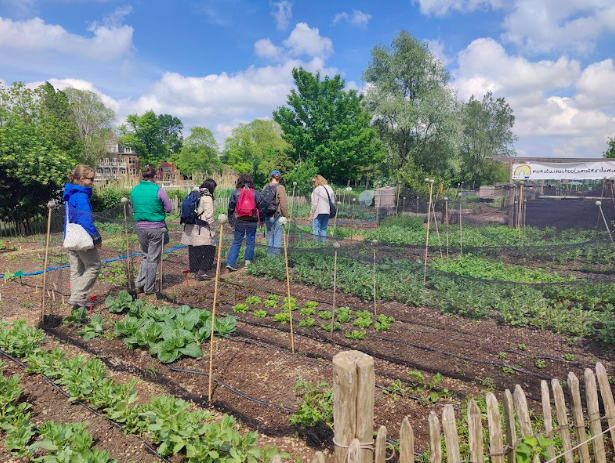
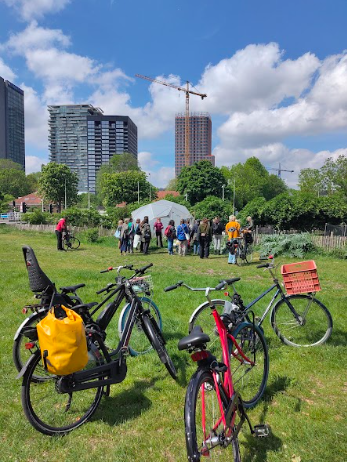
Left: Admiring the students’ beds at the Moestuinschool. Right: The Moestuinschool, with frenetic building activities along the River IJ in the background.
Voedseltuin Ijplein: social and inclusive gardening
Our tour continued along the eastern banks of Amsterdam North to Voedseltuin Ijplein, one of the first community gardens in Amsterdam, founded in 2014. This garden is volunteer-run and has a social focus: the harvest goes to the local food bank, as well as the Resto VanHarte, a nearby community restaurant with affordable prices.
A great deal of care has gone into the sign at the entrance to the garden, which is in Dutch, English, Turkish, Arabic and also has clear symbols for non-readers. The ‘rules’ of the garden are clearly illustrated: everyone is welcome to enjoy the garden as long as they don’t walk on the beds or sneak away with the harvest!
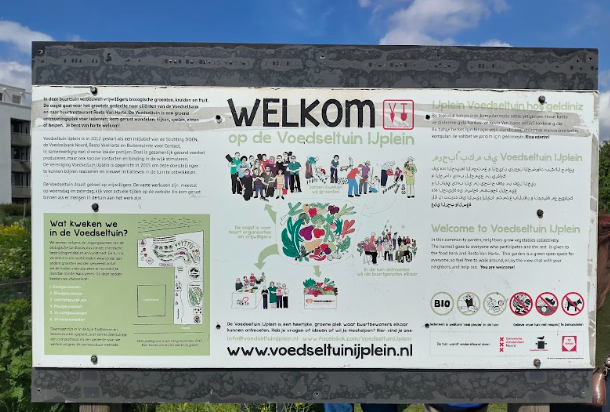
Multilingual welcome sign at Voedseltuin IJplein
Most people don’t know that this garden exists, despite its significant size. Tucked in among housing flats, its panoramic view of the IJ river offers a surreal backdrop to the carrots and fava beans when gigantic cruise ships float by. Our bike tour students were particularly enchanted by the abundant herb garden, where we took turns smelling aromatic plants including lemon verbena, cola herb, curry plant and lavender, watched the bees pollinating the little orchard, and checked out the new underground rainwater storage system with capacity to store 50,000 liters. This pioneering system will be rolled out to other community gardens in the city if it’s successful!
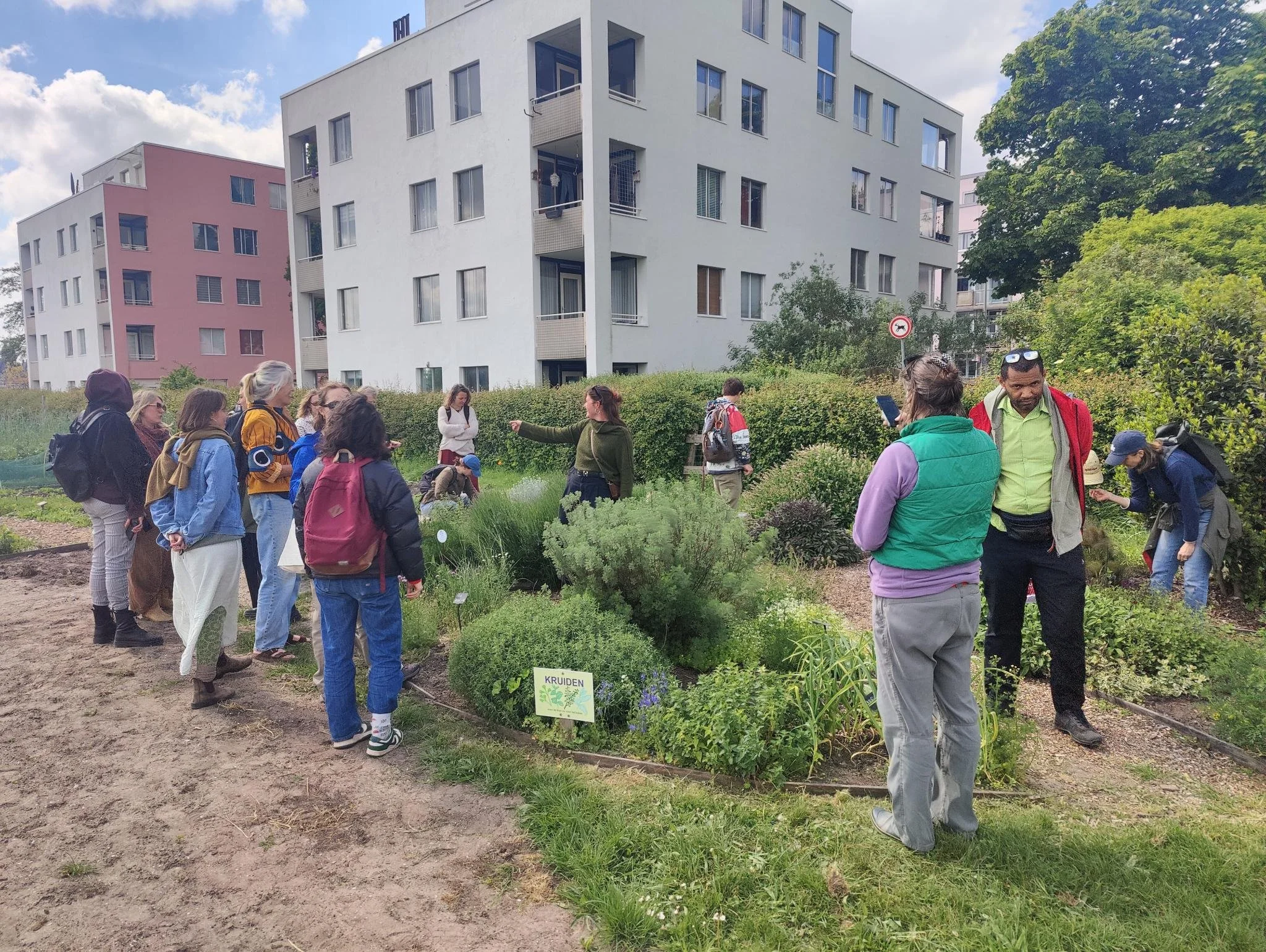
Herb garden at the Voedseltuin IJplein.
Beeldbos Vliegenbos
Next we biked through the Vliegenbos, Amsterdam’s oldest city forest. Created for workers and the public in 1917, it has one of Europe’s last mixed elm forests and is home to foxes, hawks, owls, kingfishers and a very rare glow worm. In the summer months you can join the Nachtverbond (the Night Alliance) for an evening expedition through the forest to look for glow worms as well as bats, hedgehogs and other nocturnal animals.
We parked our bikes at the end of the forest at the Beeldenbos Noord sculpture garden. This three-hectare forest is home to a rich variety of native plants and trees, interspersed with sculptures by artists from Amsterdam and beyond. We were warmly welcomed by Bert van der Kamp, the caretaker, and his friendly dog Kees who joined us in a stroll along the leafy paths of the garden, each twist and turn revealing another intriguing sculpture.
Beeldenbos Noord is also an official tree hub for MeerbomenNu, a coalition of volunteers and foresters who rescue young trees and shrubs in overcrowded nature areas so they can grow to maturity elsewhere. In the spring of 2026, visitors could pick up various small trees (including oaks, dogwoods, blackthorn, elderberry, hawthorn, hornbeam, birch and willow) as well as gooseberry, blackcurrant and grape cuttings. Read an article about Cityplotters Eva and Jaffie picking up trees to spread around the city here!
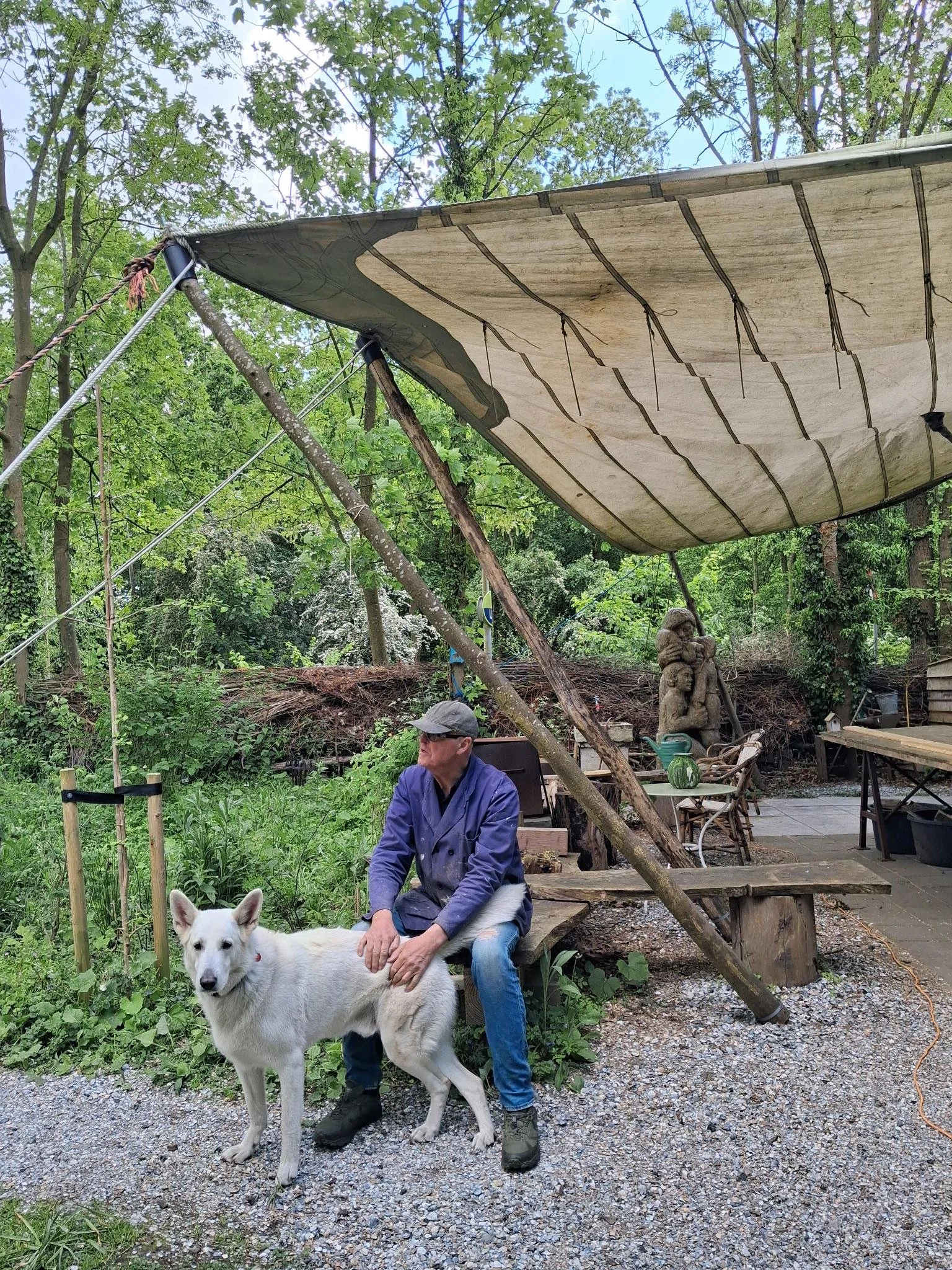
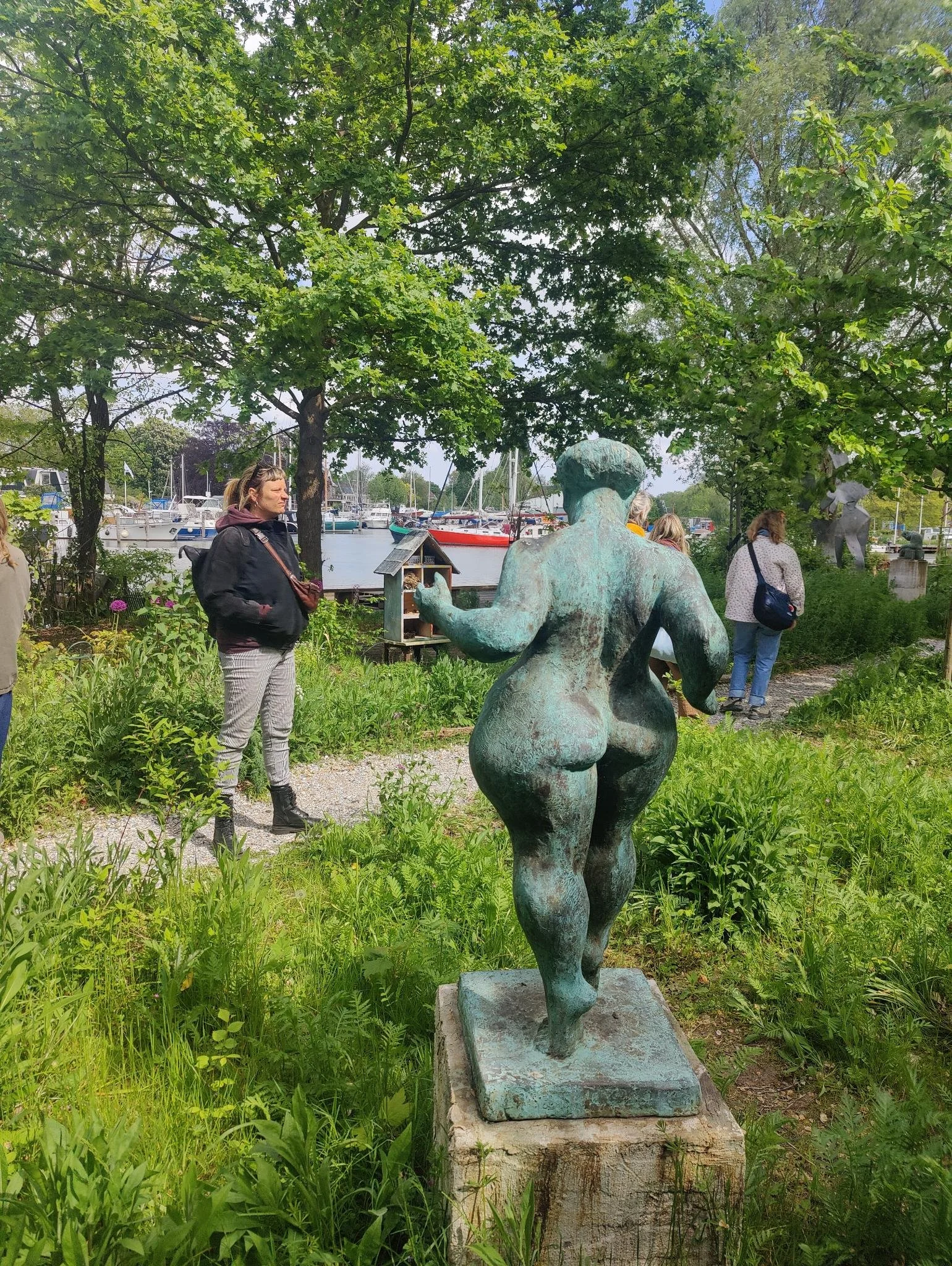
Left:Beeldenbos Noord caretaker Bert van der Kamp and his dog Kees. Right: Bert explained that this sculpture depicts a woman on tiptoe to avoid stepping on a snake.
VerbroederIJ: building camraderie
Our last stop of the day was at yet another gem of Amsterdam North: De VerbroederIJ, a cobbled together mixture of recycled and repurposed materials on a sandy beach overlooking the IJ. The name translates to ‘building camraderie’, and the vision share by its pioneers is to create inclusivity, sustainability and connection in the neighbourhood. All of the programming is free – from neighborhood lunches to Zumba lessons, and from upcycle workshops to campfire concerts. The garden, also known as the ‘MoestuinderIJ’, welcomes volunteers to help grow food in raised beds for themselves and for the kitchen (you can contact the author of this blog if you want to lend a hand!). The ‘ZaagerIJ’ is a group of handy volunteers who take care of all kinds of building and repairs around the location. De VerbroederIJ is also home to Helen’s Free Food market, which feeds 100 households each week with leftovers from local bakeries, greengrocers, supermarkets and wholesalers.
Like most of the locations we visited on the bike tour, the fate of this beloved hub for neighbours and beyond is uncertain. Created after winning a tender for a short-term project in 2018, De VerbroederIJ’s tenure was extended in 2022 for another few years after 10,000 people signed a petition to allow it to stay. Recently this permission was extended for another five years, although 6500 homes will be built around its perimeters during this period so it may lose some of its idyllic character.
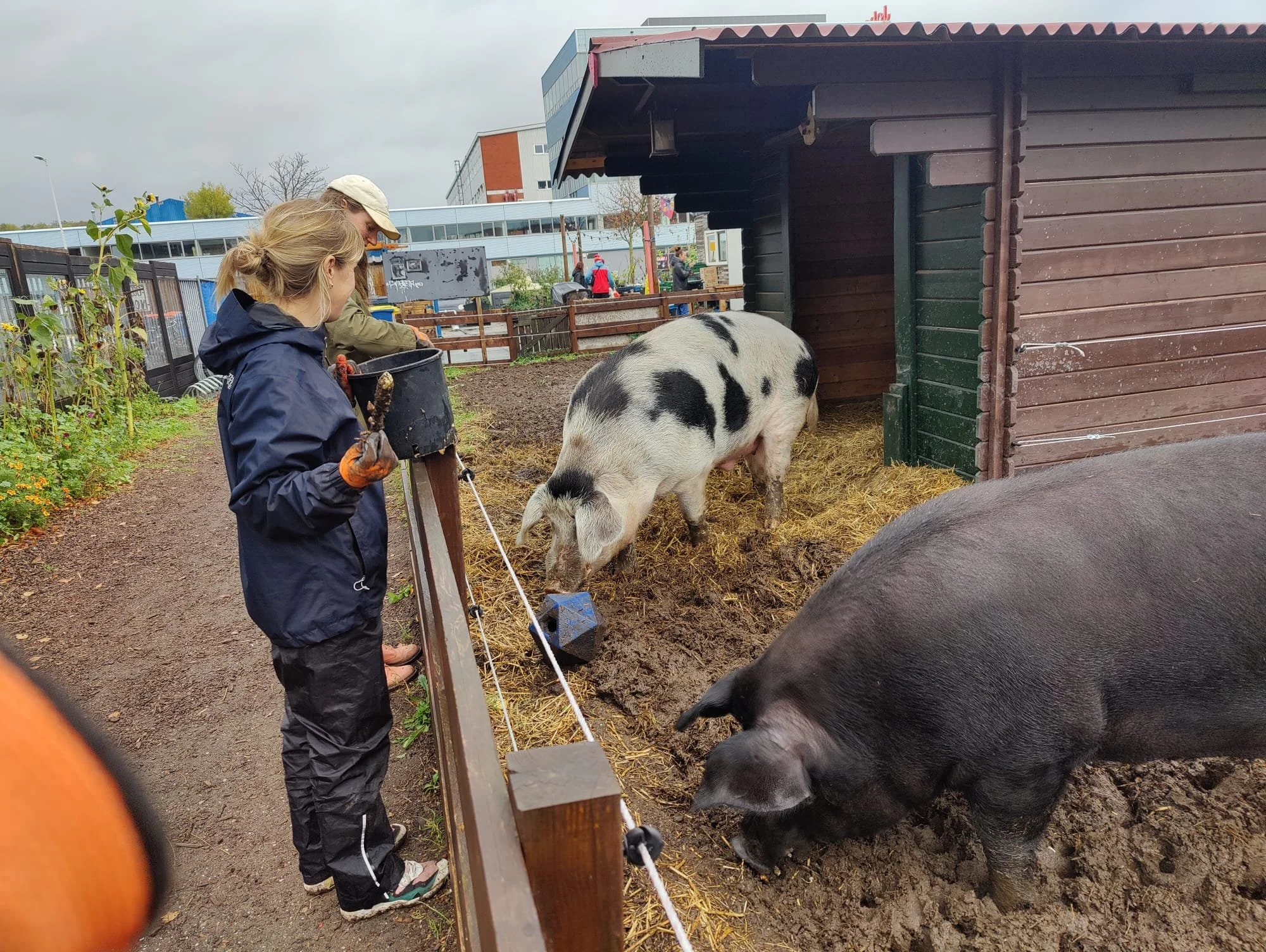
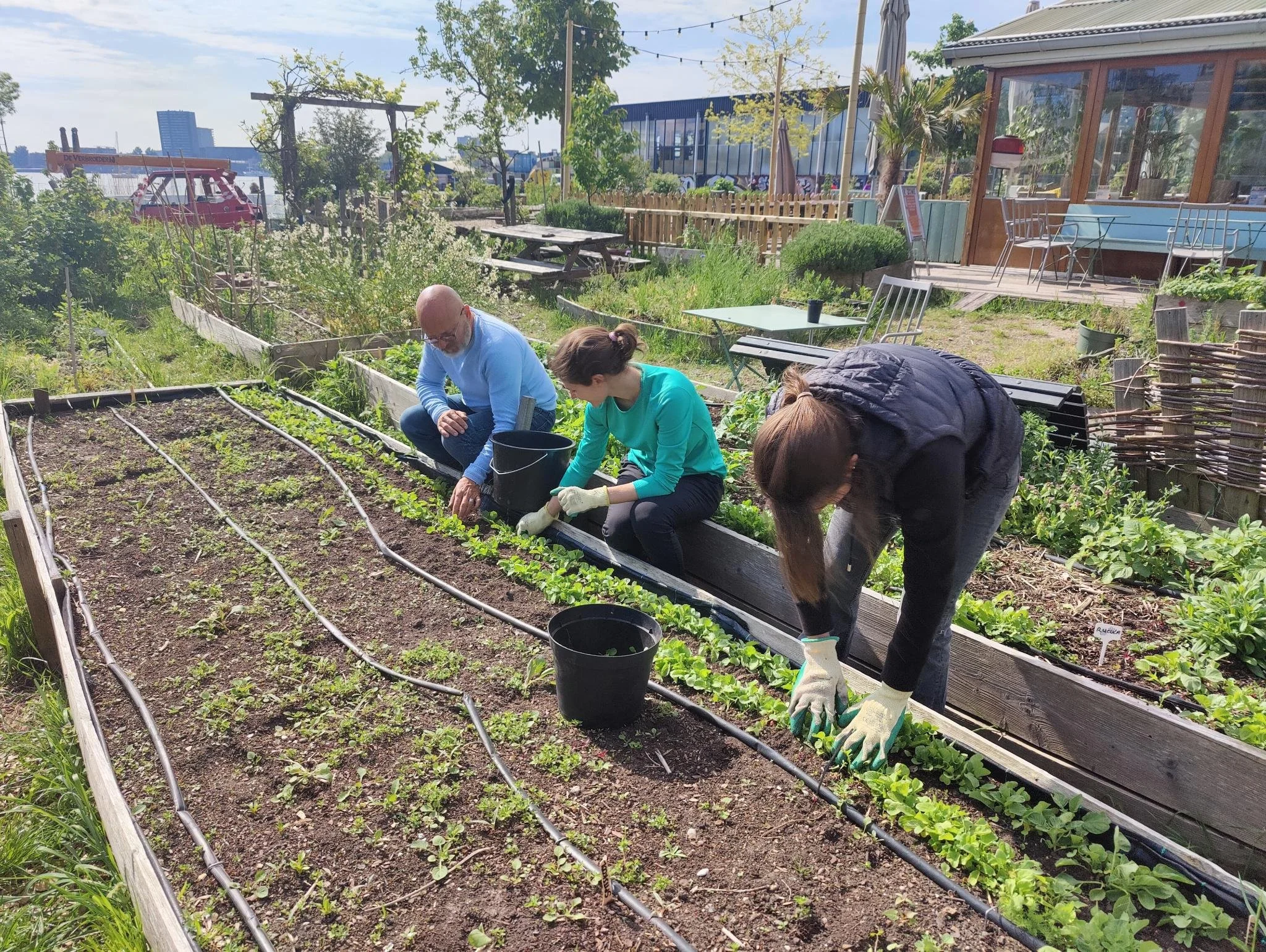
Left: Barry and Rosita, the pigs at the VerbroederIJ who devour the food waste from the kitchen. Right: Gardening at the VerbroederIJ.
Protect the edge!
Today, Amsterdam Noord is still one of the city’s last remaining spaces for experimentation, creativity and community building. In a rapidly gentrifying Amsterdam, where many are being pushed out or marginalised due to rising costs, the social value of these projects can not be measured in financial terms. What they contribute is invaluable: they strengthen the social fabric by creating places of connection; they help to fight loneliness, depression and hunger; they sustain vibrant and joyful volunteer networks; they create solidarity; they sustaining local economies; and they create space for experimentation and innovation in sustainability and circularity.
Although the city council acknowledges the essential role these initiatives play and proposes to make them permanent (their 2020 report Expeditie Vrije Ruimte stated “Urban open space is not a luxury, but a necessity for healthy and sustainable cities”), very little has happened to this end. Following the bike tour, Urban PDC student Jules observed: “It was contradictory to see the twin heads of dragons in the same beast … that in the council there are folks who are doing exciting work on showing the evidence that these initiatives work and in the same beast, others pushing for the economic arguments. How can we swing the argument?” Time is short, as the march of gentrification and development are erasing the fringe and making Amsterdam more homogenous, less transformative, and less fun. How can we make sure that the initiatives that are pushing the edges but that are less economically profitable are sufficiently valued and protected?
You can help to keep these vital initiatives and spaces alive. Here are a few ideas!
1) Support these spaces! Become a member, make a donation, go along for a coffee and a chat! Tell your friends and neighbours!
2) Follow and support some of the organisations that are working to keep Amsterdam Noord edgy! For example, Red Amsterdam Noord is a group of Noorderilingen of all ages who are working to protect the area’s unique initiatives.
3) Let us take you on an eye-opening bike tour to some of these initiatives and more in Amsterdam Noord! Contact: toursams@cityplot.org

Ann Doherty
Amsterdam Coordinator
Stadsboerderij Osdorp, Pluk! CSA founder, Workshops, Garden Consultations, Tours & Outings