Community connections -3
Planting Palestine
There came a moment when I could no longer keep scrolling.
The images of grey concrete and rubble became too much. Poisoned water sources. Uprooted olive trees. No trees left to give shade. A ban on foraging your own land. Last year I was in an online meeting with Palestinians connected to a seed reproduction facility in the West Bank that had just been destroyed. Something in me shut down after that. A kind of helplessness set in.
Six years ago I made a life change to become a permaculture designer. I started growing food, living with the cycles of seasons and saving seeds. And I had been carrying a deep love for Palestinian food culture for years, without knowing what to do with it.
What if I planted that love? Literally.
I decided to plant a garden of abundance. A Palestinian heritage garden. Not as a political statement from above. As a tribute from the ground up. Quiet, stubborn, rooting.
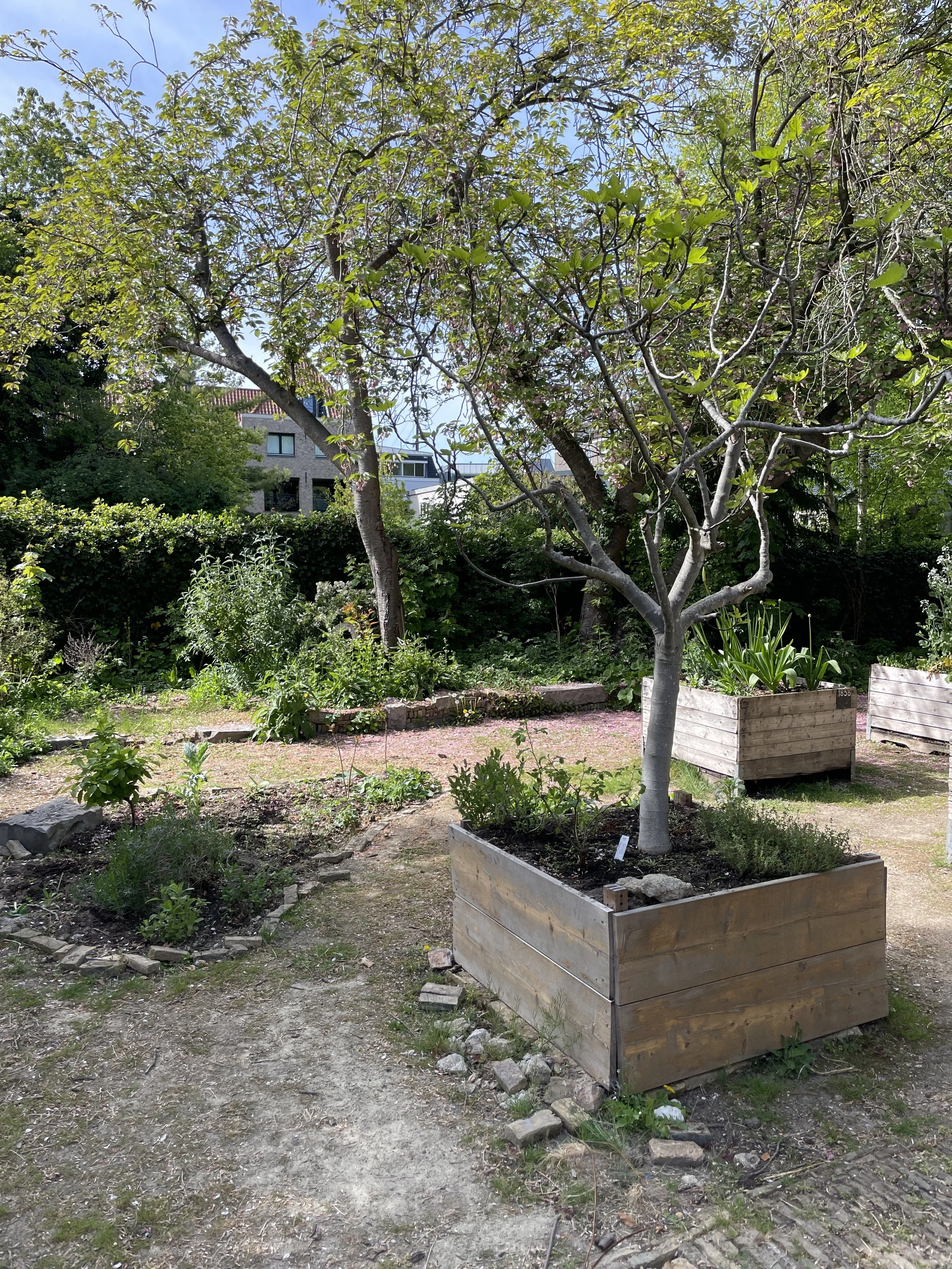
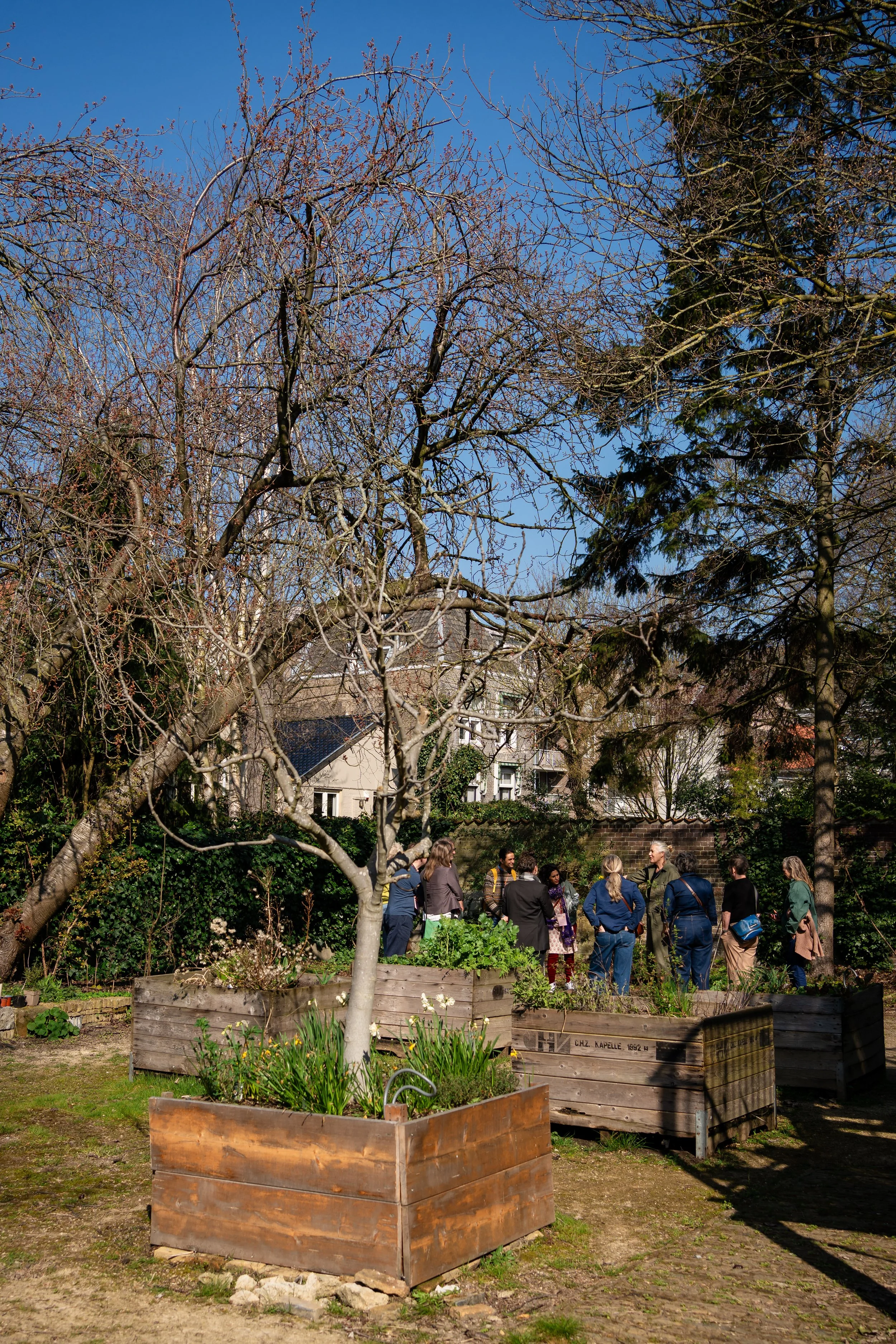
The sunny, sheltered heart of the Silent Garden at Food Design Playground with the fig tree at the centre. Around it: the Palestinian heritage beds, planted with za'atar, nigella, lathyrus, sumac, mallow, cardoon, plum tree. And more to come.
The Silent Seeds Garden
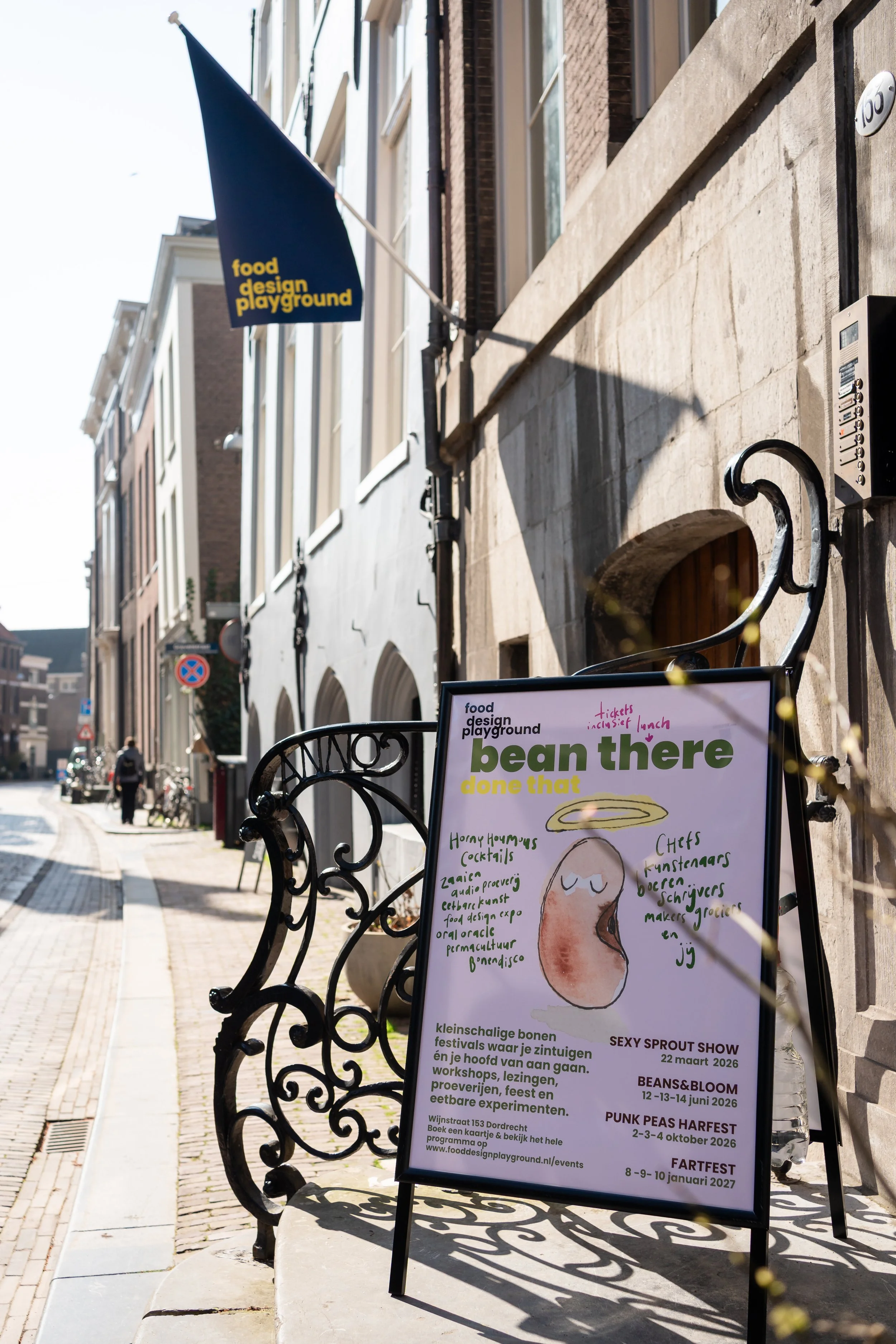
As artist in residence at Food Design Playground in Dordrecht, I am creating a large back garden at Marije Vogelzang's new project — a living laboratory in a historic house in the city.
This first year, the Playground is dedicated to the bean. All kinds of beans. The chickpea too. And within that, I decided to reserve the sunny, sheltered heart of the garden entirely to Palestine.
I did not do this alone.
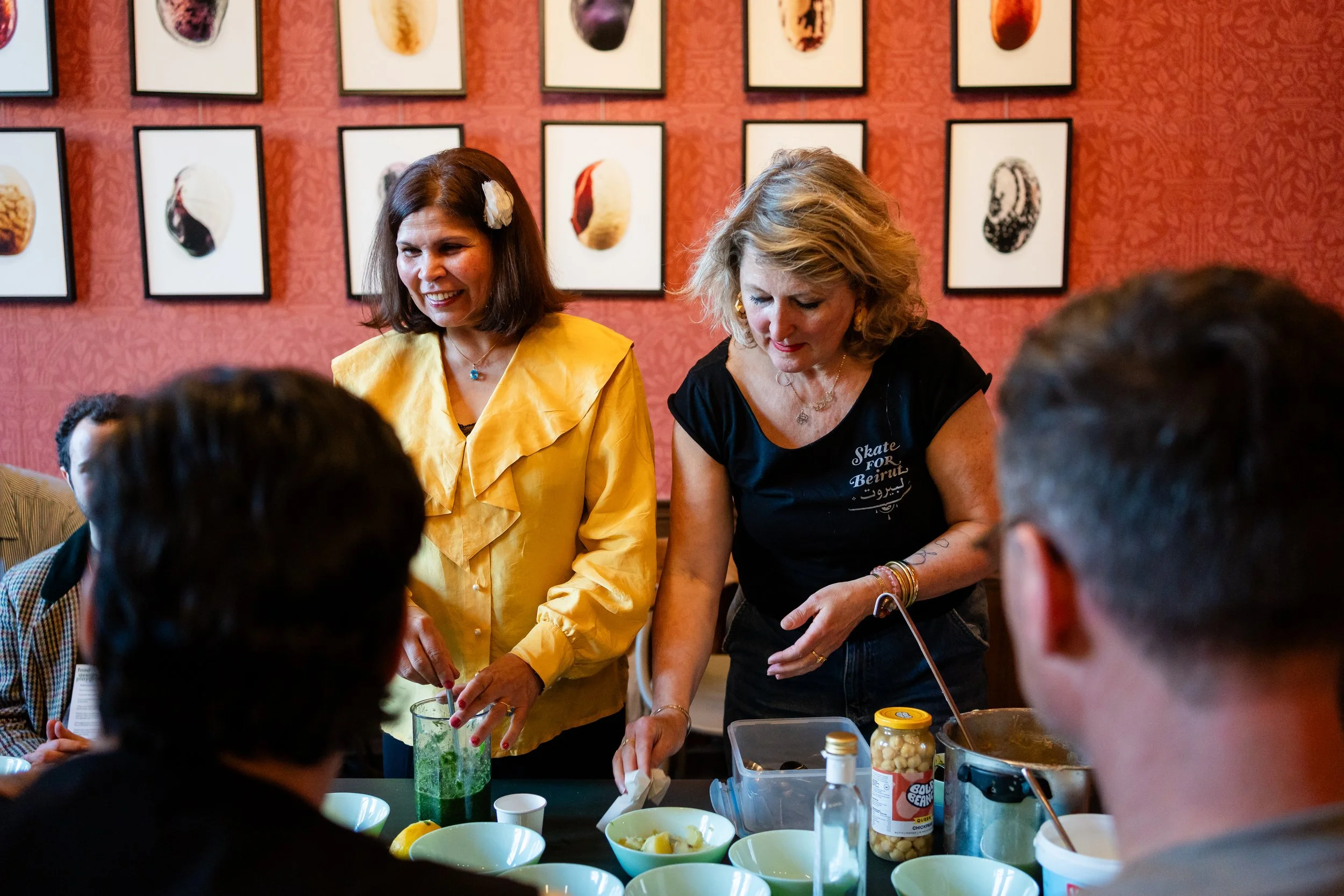
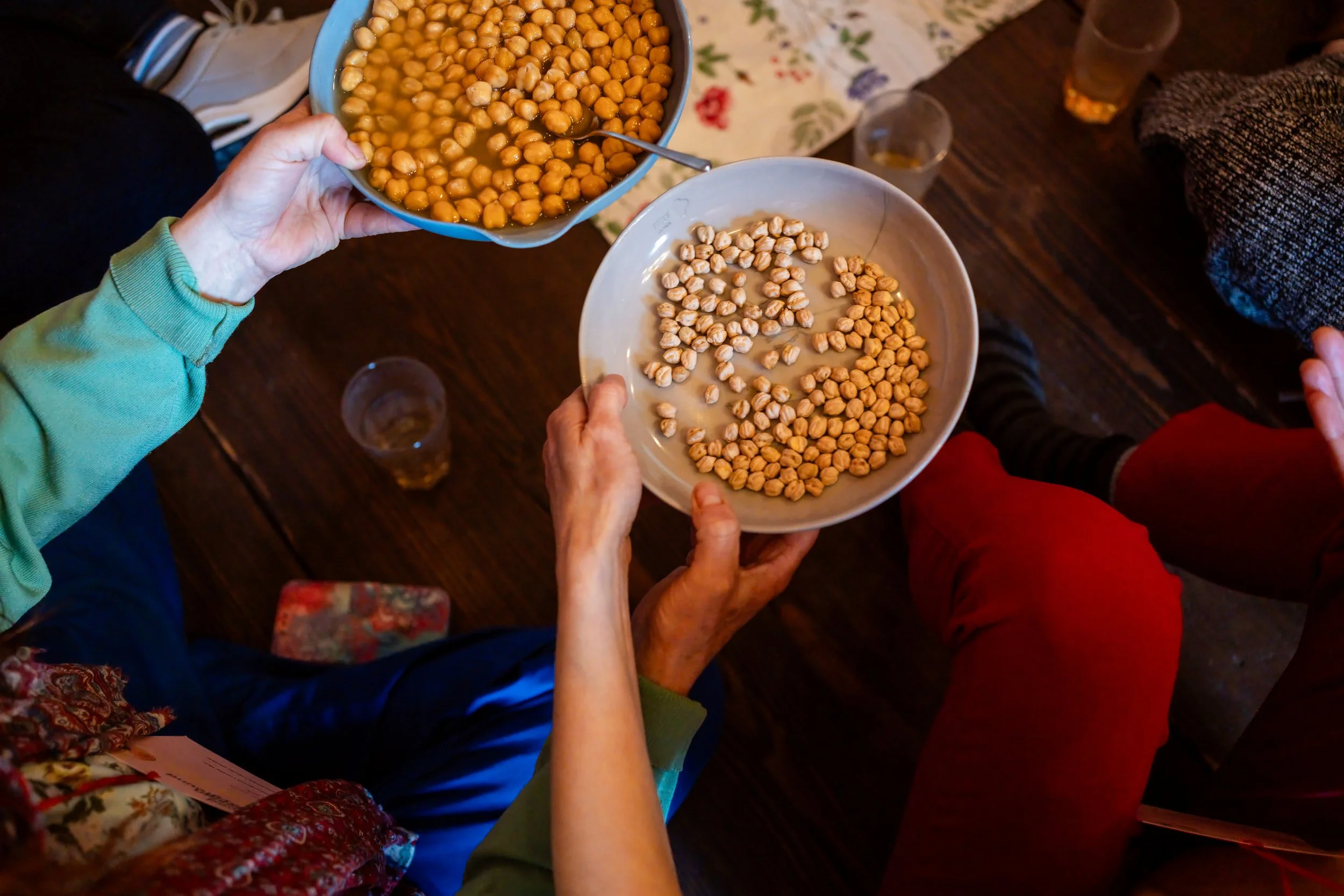
Shahnaz Shah (left) en Merijn Tol (right) during workshop The Chickpea People at Food Design Playground.
Photo by Daisy Tuinder
The people who feed me with inspiration
It started with a conversation with Merijn Tol, food writer, chef, and right in the middle of writing her new book — titled Hommos — tracing the history and politics of the chickpea and the world's most contested dip, with an activist edge. Drawn to her way of seeing, the Palestine garden took shape from there.
She introduced me to Umayya Abu-Hanna and Maryann Jaraisy, the Palestinian women behind the Hummus Academy — an Amsterdam-based foundation dedicated to what they call the decolonisation of indigenous cuisines: reclaiming Palestinian food culture from the narratives that erase or appropriate it. Writers, researchers, cultural workers who have lived abroad for decades while staying deeply connected to their heritage. Through events, dinners and their book Een Palestijns Diner — part cookbook, part cultural manifesto — they reposition dishes like hummus, fattoush and musakhan as living expressions of a specific land, a specific people, a specific knowledge system. Not generic "Middle Eastern" food without origin or memory.
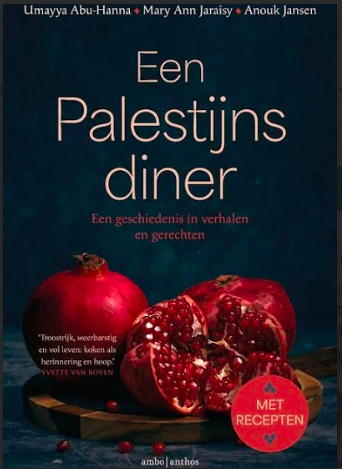
I read the book. I listened to podcasts late into the night. I asked a lot of questions. What followed was deep research into plants, history, soil and politics. Umayya and Maryann gave me more than information. They gave me a way of seeing the land as relationship, not as resource. This garden grew from that generosity.
Merijn put it simply, and it stayed with me: "The generation that knew is no longer here.
That is exactly what this garden tries to do — keep alive what would otherwise disappear."
13,000 years — and a map without borders
Here is what surprised me most.
Palestine and the Levant are literally the birthplace of agriculture. Thirteen thousand years ago, people on these hillsides did something new. They stopped just gathering. They buried a seed with the intention of coming back to find it. Wheat, barley, lentils, chickpeas, figs, grapes, olives. All first cultivated here.
Umayya helped me see the geography differently. Palestine is not an isolated conflict zone. It is part of the Mediterranean world. Seeds, plants and recipes travelled west from Jaffa by sea, reaching Greece, Italy, North Africa, Europe. The olive tree, the fig, the grape — shared ancestors. Palestine is also part of the Shaam, the collective cultural and agricultural landscape of Palestine, Lebanon and Syria. Same climate, same plants, same names for herbs, same ways of caring for the soil. The borders we draw today are recent. The plants do not know them.
For thousands of years, the people of this region lived in deep relationship with their landscape. Borders followed the natural rhythms of bio-regions and watersheds, not the lines drawn on colonial maps. What Palestine has been, and still is as living heritage, is a culture of consciousness with nature. Not a dominant relationship but something closer to listening, dancing, reciprocity. Thankful. And full of an almost magical attentiveness to the world.
That is what I want this garden to carry.
Ba'al — resilience rooted in listening
In traditional Palestinian farming, crops grown on rainfall alone are called ba'al. Named after Ba’al, the ancient Canaanite god of fertility — a Semitic word meaning “husband” in Arabic and Hebrew. The plant that belongs to the rain. No irrigation. No dependency. Ba’al varieties have built a relationship with the specific soil and rain patterns of their place over centuries, through knowledge passed down orally from generation to generation. Alongside ba’al farming, a third of all Palestinian land was traditionally held as Masha’a — collective land, open for foraging, grazing, and communal use. Both systems were rooted in the same principle: land as shared relationship, not private possession.
They are drought-resistant not because they were bred to be, but because they were listened to.
As a permaculture designer, I recognised this immediately. It is exactly what we mean when we talk about working with nature rather than against it. But Palestinians had a word for it long before permaculture did. In a time of climate crisis, when water scarcity is reshaping agriculture worldwide, this ancient knowledge feels more urgent than anything in my bookshelf.
Those solutions live in the seeds. And the seeds are under threat.
Weed control — the grammar of erasure
In 1940, a Jewish farming organisation sent the British authorities in Mandatory Palestine an illustration of 33 seeds, titled Seeds and fruits of weeds found in crops. The plants were described as "unwelcome", "troublesome", "alarmingly spreading", "must be combated." A call to eradicate Palestinian wild plants from the agricultural landscape.
Eighty years later, Palestinian curator Yazid Anani invited 33 artists to reimagine each of those seeds. The Weed Control exhibition, Ramallah 2020, A.M. Qattan Foundation.
The colonial language of weed control and the language used to describe Palestinian people are the same language. Invasive. Unwanted. To be contained.
Artist Mahdi Baraghiti, who participated in the exhibition, said it plainly: "They try to bury us and we grow again. We are like these plants — they try to kill us, we grow again."
There is also the Zionist narrative of "making the desert bloom" — land as a lost paradise to be reclaimed, healed from infection. The Silent Seeds Garden tells the opposite story. Not a paradise to be conquered, but a relationship with land to be preserved and passed on. A seed is folded time. A garden is memory, not possession.
In this garden, the weeds grow freely. The mallow along the edges, the poppy between the beans, the purslane coming up by itself. They are not removed. They are named.
Four gardens — and the one permaculture forgot
My research led me to the traditional Palestinian garden concepts near the home. And here is where things got genuinely exciting, because I recognised everything and I hadn't expected to.
Il-hakura is the intensively managed kitchen garden. Close to the house, close to the kitchen, tended daily. In permaculture we call this Zone 1 — the most visited, most productive space.
Il-bustan is the walled orchard. Fig, pomegranate, grape, almond, mulberry, quince. Perennial, structural, giving shade and fruit across the seasons.
Il-hadiqa is the polycultural family landscape. Layered, regenerative, built for the long term. Ecological succession made visible. The backbone of any food forest design.
And then there is el-jneini.
The little paradise garden. From janna — paradise — and jinn — spirit. The place where the spirits of the place live. The family's art and culture space. A flower garden, a place of beauty, reflection and the invisible made visible.
When Umayya told me about this, I was super delighted. Because this is exactly what permaculture design tends to forget. We are very good at function. Nitrogen fixers, dynamic accumulators, groundcover, yields. We think in systems and outputs. But beauty? Fragrance? The space to sit and do nothing? The spiritual dimension of a garden?
El-jneini gives this a name. And a place. In the traditional Palestinian home garden, beauty was not decorative. It was structural. It belonged.
I gave el-jneini its own bed under the fig tree that was already there. Planting edible flowers to brighten both the garden and the kitchen. Damascus rose petals, cornflower, crown daisy, borage, zinnia. The saffron crocus that blooms in October when everything else is sleeping. And anemone, cyclamen, the Palestinian iris, named national plant in 2016. Not productive. Not edible. Just present. There to be seen.
"They thought they buried us. They did not know that we were seeds."
poet Dinos Christianopoulos
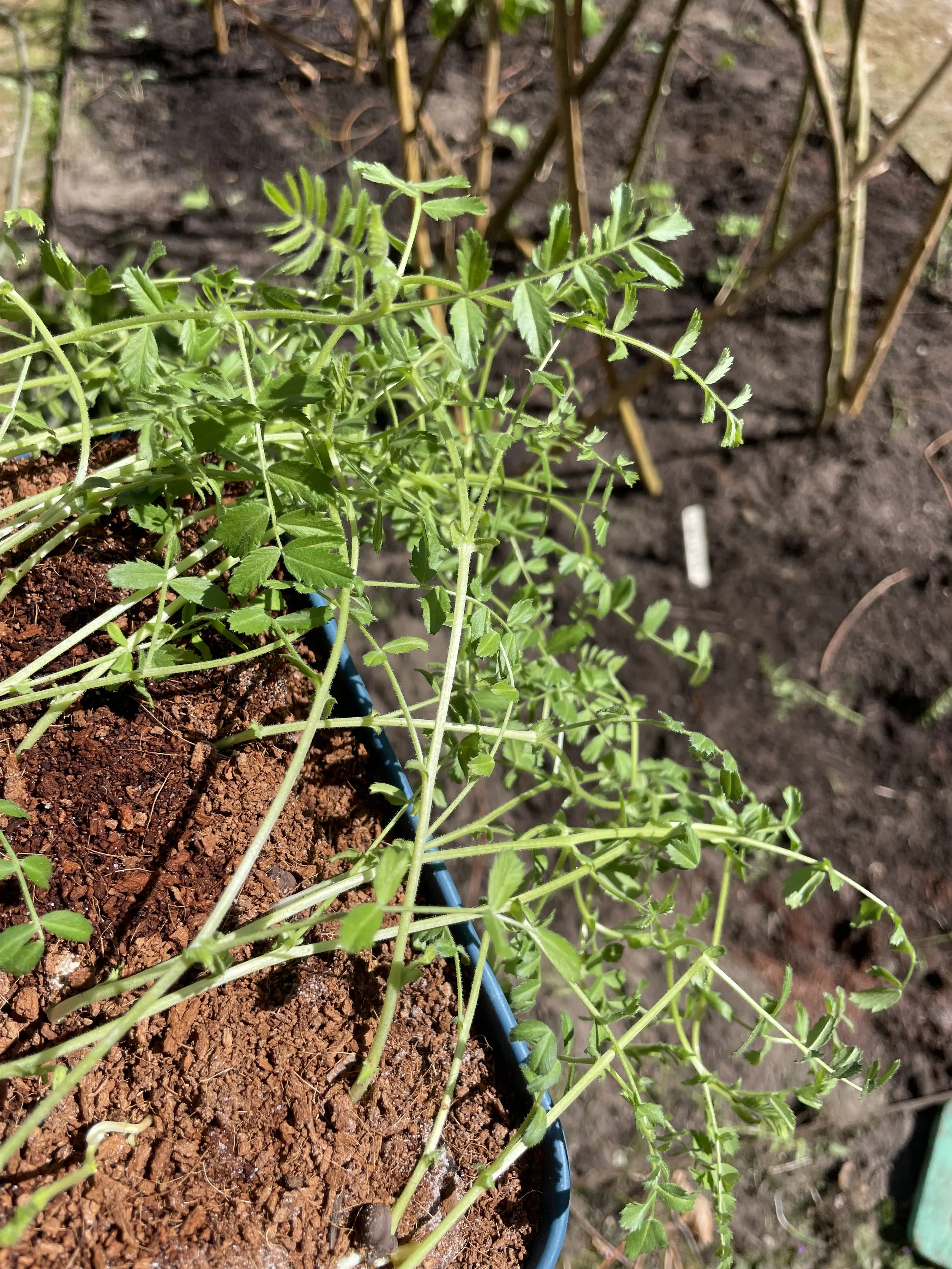
Young chickpea plants — Cicer arietinum — in their first weeks above ground. The chickpea is one of the oldest cultivated crops on earth, first domesticated in this very region more than ten thousand years ago.
Do Palestinian plants grow in the Netherlands?
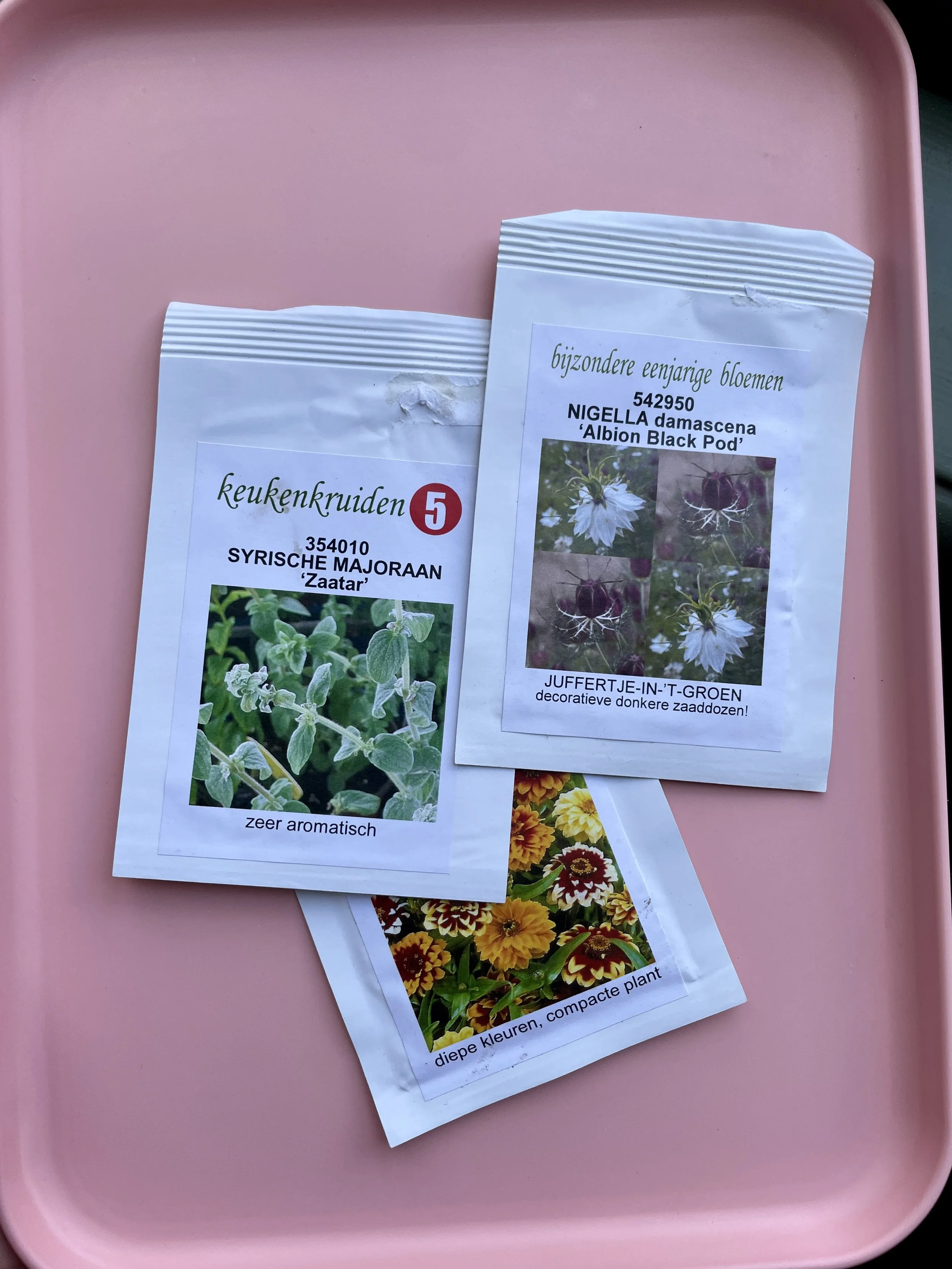
This is a question I asked myself early on and the answer turned out to be more hopeful than I expected. The Mediterranean climate of Palestine is warmer and drier, but many of the plants that define Palestinian food culture are surprisingly adaptable. Za'atar (Syrian marjoram) grows readily here and even overwinters in a sheltered spot. Nigella damascena — juffertje-in-'t-groen, as Vreeken's Zaden calls it — is native to the wider Mediterranean and thrives in Dutch summers. Chickpeas need a long warm season but can be grown successfully in a raised bed with good drainage. Lathyrus, the edible vetch, is a cool-season legume that actually prefers our climate. Saffron crocus blooms in October. The fig tree at the centre of the Palestinian garden was already there. I planted Sumac.
Where the Dutch climate makes things genuinely difficult — aubergine, Aleppo pepper, molokhia. A greenhouse, which we are currently seeking, would open up even more possibilities.
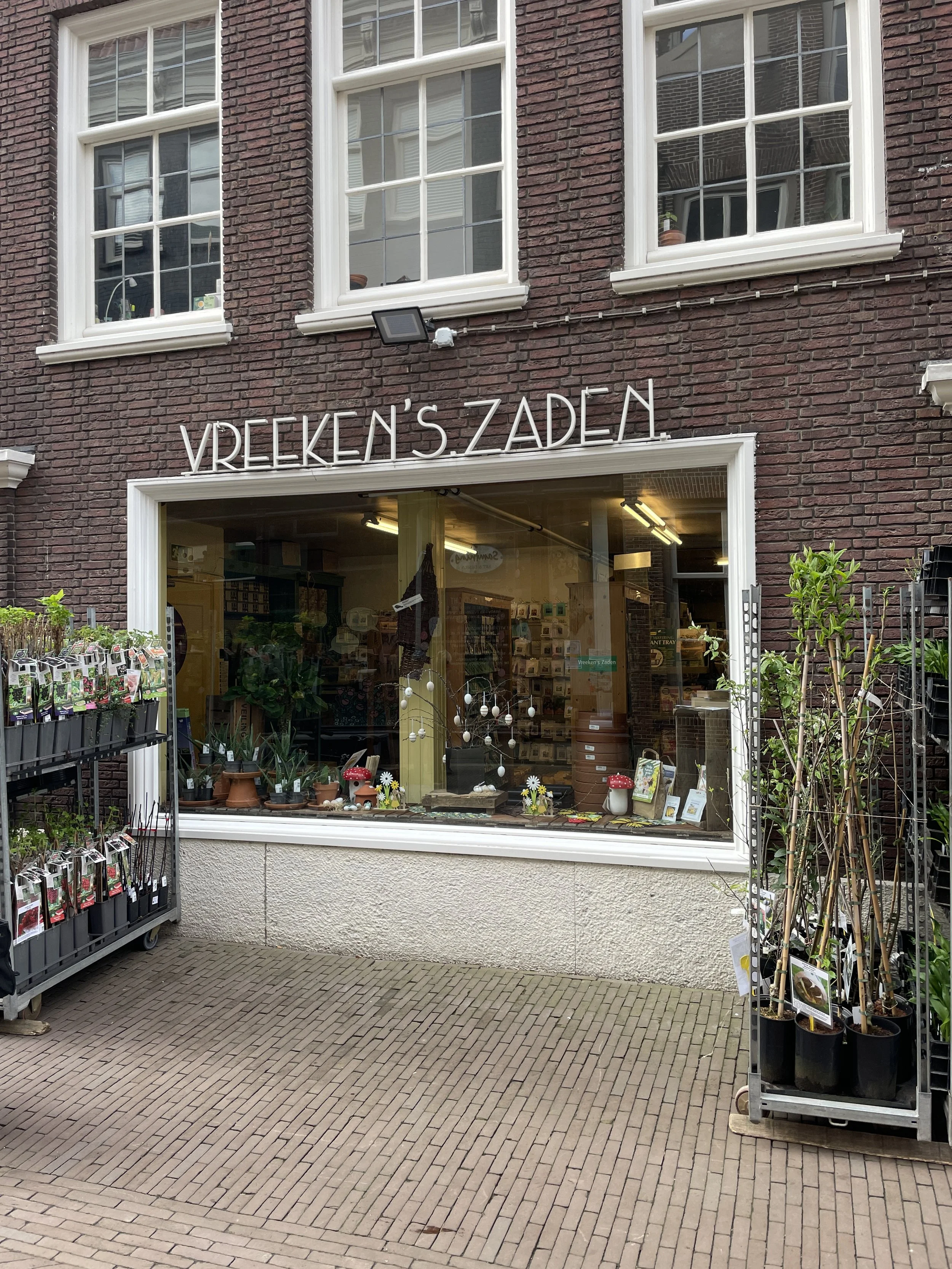
The seed planted in this garden came partly from Vreeken's Zaden, the century-old seed shop here in Dordrecht.
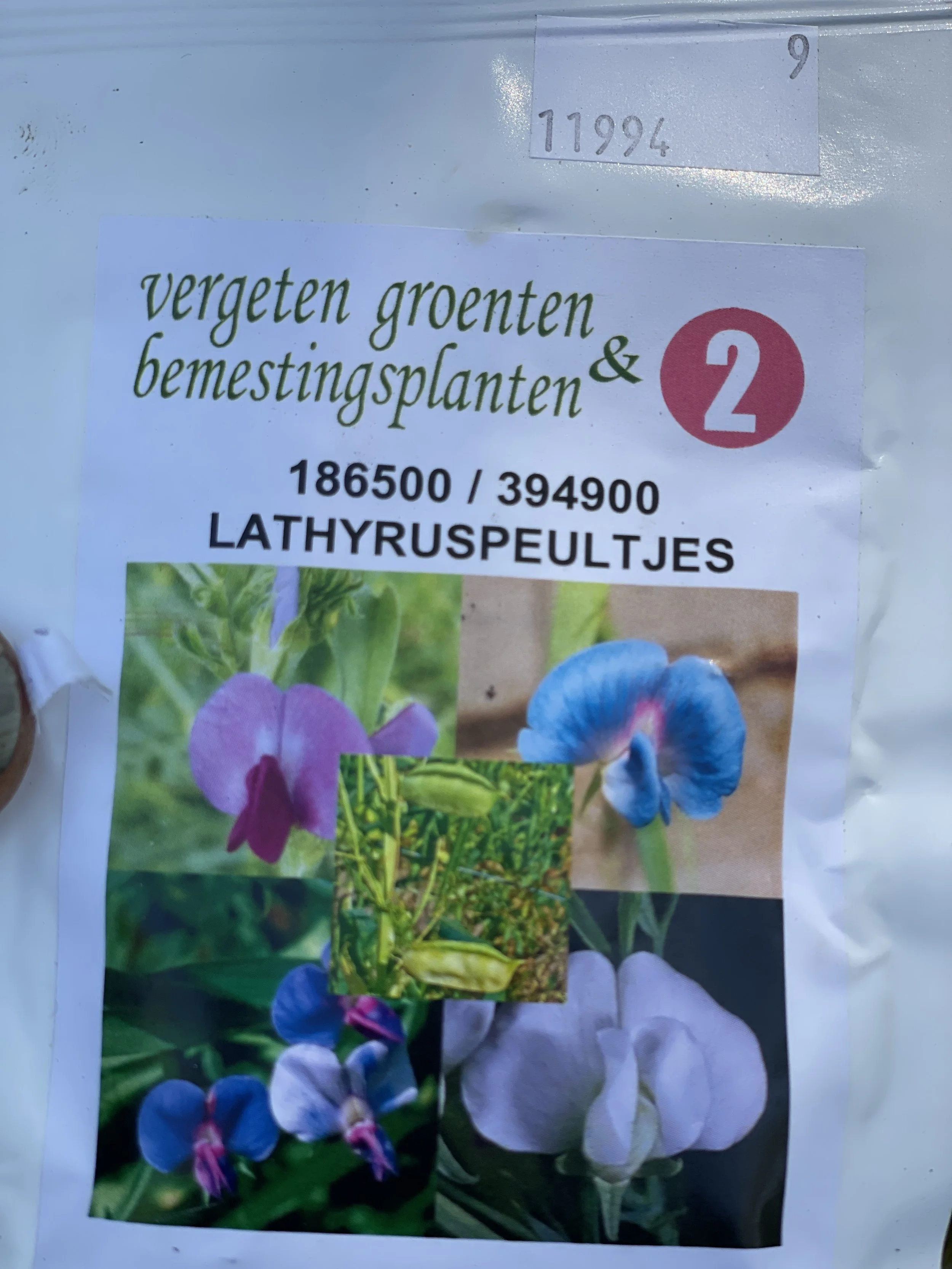
Above from left: 1.Lathyruspeultjes — edible vetch — from Vreeken's range of 'vergeten groenten', forgeotten vegetables. A legume that fixes nitrogen in the soil, feeds pollinators, and produces beautiful blue-purple flowers before the pods appear.
2. Seeds from Vreeken's Zaden that now live in the Palestinian garden: Syrische Majoraan 'Zaatar', Nigella damascena 'Albion Black Pod' (juffertje-in-'t-groen), and zinnia. All sourced within walking distance of the garden, from a shop that has been selling seeds in Dordrecht for a hundred years.
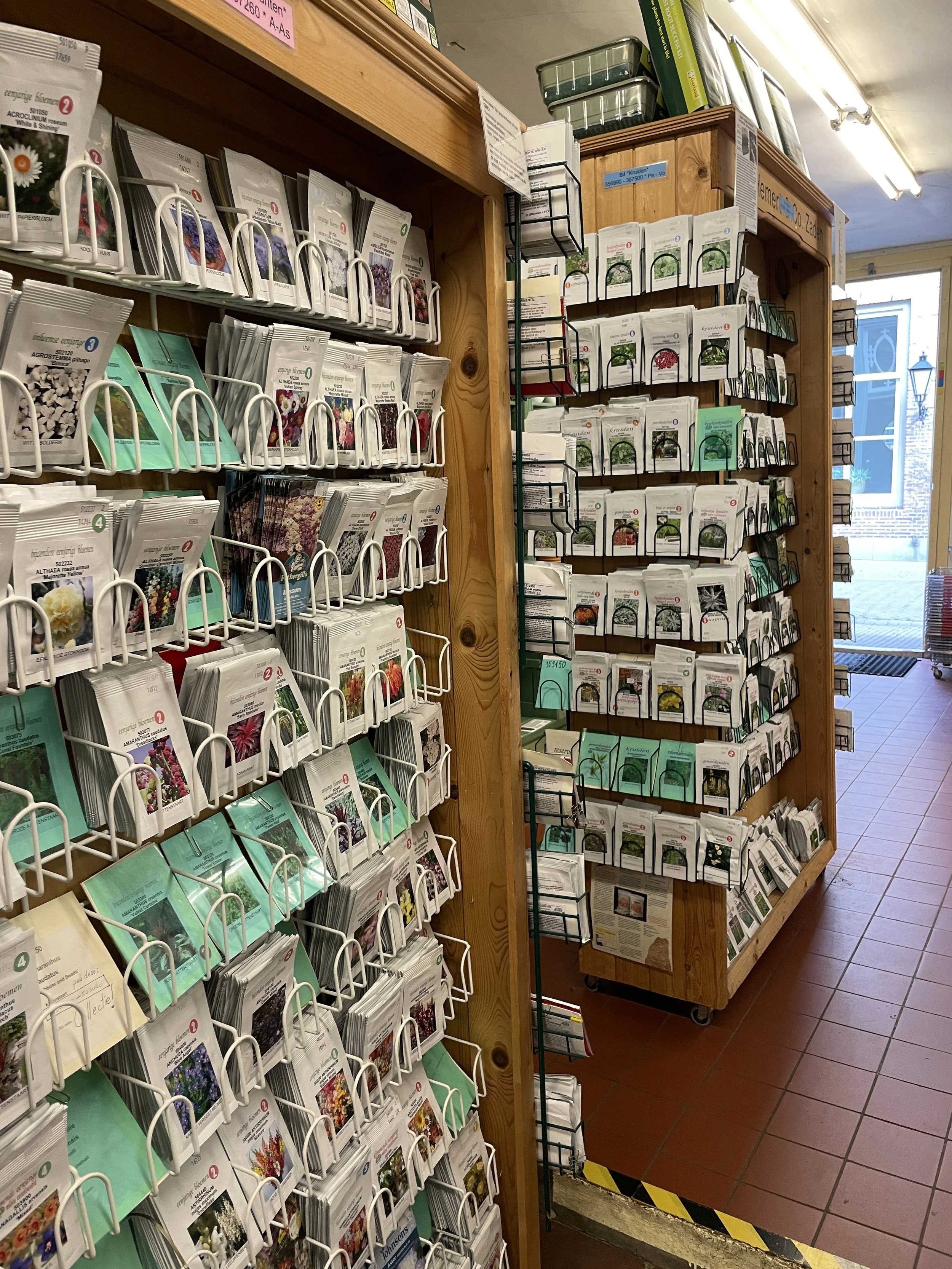
3. Inside Vreeken's: hundreds of seed varieties, floor to ceiling. A candy store for gardeners.
4. Vreeken's Zaden, celebrating its centenary this year, at the centre of Dordrecht.
Come and see it grow
The garden follows a full year cycle: sowing, growing, harvesting, composting, giving back. Nothing disappears. Everything returns.
Curious about the garden and the stories it holds? On 13 & 14 June, the Silent Seeds Garden opens its gates for Beans & Bloom.
On Saturday, the Hummus Academy hosts a Palestinian lunch experience - food as living memory.
On Sunday, a full festival day with workshops. Both days, a guided tour through the garden with me.
Merijn Tol presents her book Hommos at Food Design Playground on the Bean festival weekend of 3 and 4 October.
What we hope to build, slowly, is a living archive. A place where Palestinian plant knowledge is growing in the ground, available to anyone who wants to touch it, taste it, or learn from it. In times of deep grief, these seeds keep us going. They hold history. They hold hope.
Follow along. And if you have Palestinian heirloom seeds to share — please get in touch!
Acknowledgements
The Silent Seeds Garden is a collaboration with food designer Marije Vogelzang at Food Design Playground in Dordrecht, with generous input from Umayya Abu-Hanna and Maryann Jaraisy of the Hummus Academy and Merijn Tol. Supported by WECF — Women Engage for a Common Future, Ecofeminists in Action for a Healthy and Toxic Free Future, and Vreeken's Zaden.
Sources: Hassouna, S. (2026). Weed troubles in Palestine. Geographical Research. Agroforestry for Palestine, Palestine Institute for Biodiversity and Sustainability. Philokalia Winery, Bethlehem.
https://viviensansour.com/
https://www.palestinenature.org/flora/Agroforestry-for-Palestine.pdf
https://archive.org/details/palwildfoodplants2018/page/n59/mode/2up
https://onlinelibrary.wiley.com/doi/pdf/10.1111/1745-5871.70050
https://www.palestinenature.org/flora/Agroforestry-for-Palestine.pdf
https://wineanorak.com/2023/02/03/philokalia-a-natural-winery-from-bethlehem-palestine/
by Sylvia Avontuur Permaculture designer and educator